
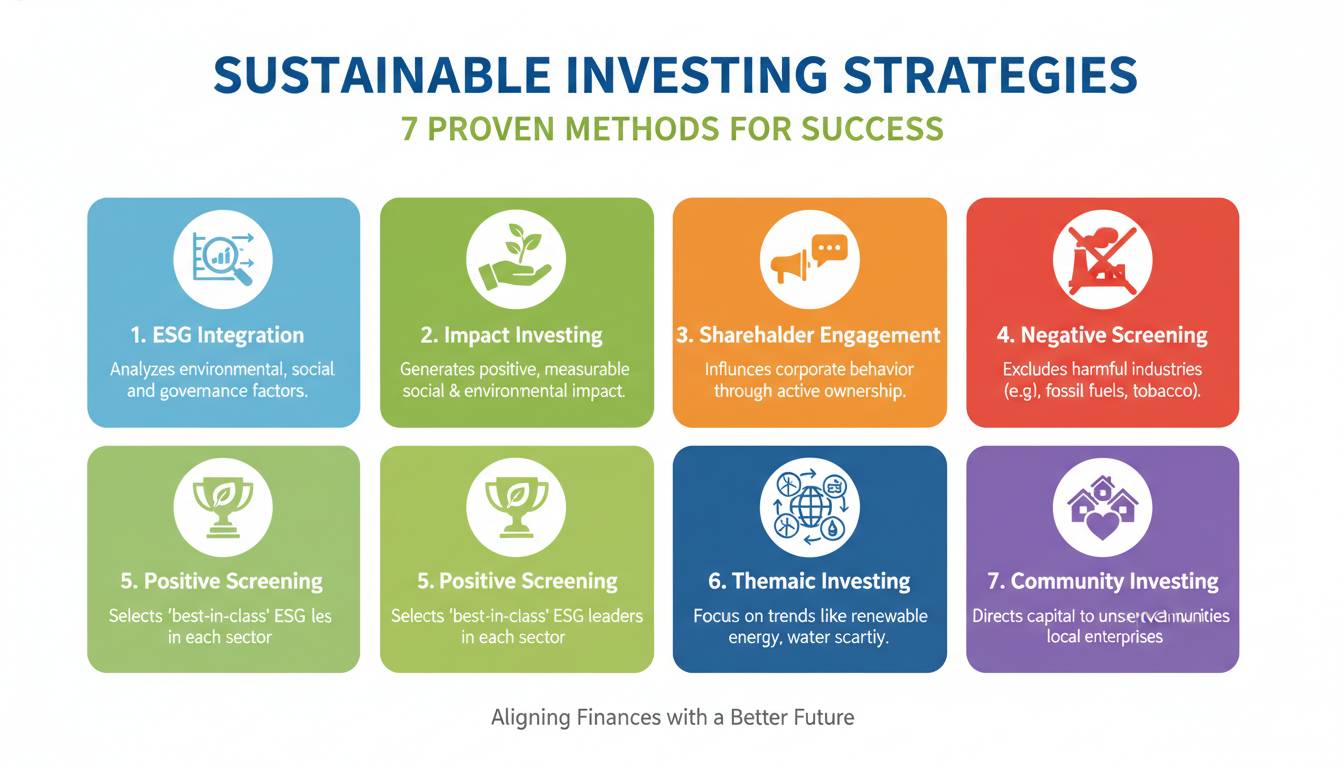
Sustainable investing has moved from a fringe interest to something portfolio managers actually have to take seriously. More investors want their money to reflect their values, and the options for doing that have exploded. This guide walks through seven approaches that can generate solid returns while supporting environmental and social goals. Whether you’ve been investing for decades or just opened your first account, these strategies give you a practical framework for making decisions that work for your wallet and your principles.
What is Sustainable Investing?
Sustainable investing—sometimes called socially responsible investing (SRI) or ESG investing—means factoring environmental, social, and governance issues into investment choices alongside the usual financial analysis. The basic idea: companies with decent ESG practices tend to perform better over time and face fewer regulatory and reputational headaches. The Global Sustainable Investment Alliance reported around $35 trillion in sustainable assets worldwide in 2020, up about 55% from 2016.
This approach looks beyond maximizing profits to consider employees, communities, and environmental impact. Investors using sustainable strategies want to find companies doing business responsibly while still delivering healthy returns. The thinking has shifted from “this is nice to have” to “this actually affects the bottom line.”
Sustainable investing covers several different strategies, each with its own methods and goals. Knowing the differences helps you pick approaches that match your values, risk tolerance, and financial objectives. Here’s how seven main strategies work.
The 7 Main Sustainable Investing Strategies
1. ESG Integration
ESG integration means adding environmental, social, and governance data to standard financial analysis. Investors use ESG scores to spot risks and opportunities that don’t show up in earnings reports or balance sheets. They look at ESG metrics alongside the numbers to make smarter decisions.
Most ESG integration involves scoring companies against their industry peers. An energy company might get a low environmental score because of its carbon footprint. A tech company might score higher on governance. These scores help investors find companies likely to succeed long-term and avoid ones sitting on ESG time bombs.
This is the most common sustainable strategy among big institutional investors. Morningstar’s research shows ESG funds generally perform comparably to traditional funds, which challenges the old idea that sustainable investing means accepting lower returns.
2. Thematic Investing
Thematic investing concentrates on specific trends and industries expected to grow while tackling global problems. Unlike broader ESG approaches, thematic strategies focus on particular sectors: renewable energy, water conservation, sustainable agriculture, electric vehicles. This lets investors put money behind causes they actually care about.
Popular themes include climate change solutions, aging populations, healthcare innovation, and resource scarcity. Investors pick themes based on what matters to them and what they think will make money. Someone worried about climate change might load up on clean energy companies. Someone focused on health might prefer medical technology firms.
Thematic investing demands careful analysis of whether trends will last and which companies are best positioned. Successful thematic investors look for companies that benefit from structural shifts, not just short-term hype. ETFs have made this much easier—you can buy a whole theme through a single fund rather than picking individual stocks.
3. Impact Investing
Impact investing aims to create measurable positive change—social or environmental—along with financial returns. This goes beyond avoiding harm. Impact investors want concrete benefits: affordable housing, better education access, improved healthcare, environmental restoration. They measure and report these outcomes alongside their financial performance.
Impact investments usually target underserved markets where money can actually move the needle. Social impact bonds, microfinance lenders, and sustainable real estate projects are common examples. Investors sometimes accept lower returns because they’re also contributing to measurable improvements in people’s lives.
The impact investing space has matured. Organizations like the Global Impact Investing Network have created standardized metrics, so investors can compare both money and impact across different opportunities.
4. Negative Screening (Exclusionary Investing)
Negative screening keeps specific companies, industries, or practices out of your portfolio based on ethical or environmental criteria. This is one of the oldest forms of sustainable investing—religious groups have been doing it for decades. You decide what you find unacceptable and remove those investments from your holdings.
Common exclusions include tobacco, weapons, fossil fuels, gambling, and companies with poor human rights records. Criteria vary widely because everyone has different values. Some investors exclude most things they consider problematic. Others focus on just a few industries that really bother them.
Negative screening gives you a clear way to make sure your money doesn’t support things you oppose. The tradeoff: you might limit your diversification and potentially sacrifice some returns by cutting out entire sectors. Many investors combine negative screening with other strategies to balance values with performance.
5. Positive Screening
Positive screening—also called best-in-class selection—puts your money in companies leading their industries on ESG issues. Instead of just avoiding the worst performers, you actively seek out the best. This lets you support companies improving their practices while still expecting decent returns.
Positive screening uses ESG scores to pick top performers in each industry. Your portfolio could hold the most responsible oil company alongside leading banks, regardless of sector. You stay diversified across industries but favor the ones taking sustainability seriously.
This strategy pushes companies to improve. When firms know investors are looking for ESG leaders, they compete to attract that capital. Research suggests companies that make the cut often show lower volatility and better risk-adjusted returns over time.
6. Corporate Engagement and Shareholder Advocacy
Corporate engagement means talking directly to company leadership to change business practices for the better. Shareholder advocacy takes this further—using your ownership rights to propose resolutions, vote on issues, and push for systemic changes. This strategy recognizes that owning shares gives you a voice.
Engaged investors might push for better climate disclosures, more diverse boards, reasonable executive pay, or sustainable supply chains. Big institutional investors often coordinate their efforts, which gives them real leverage. The logic: sustainable practices protect and grow shareholder value over time.
Shareholder resolutions have scored real wins recently, including stronger climate disclosures and board diversity requirements. Even when specific proposals fail, the voting process itself raises awareness and shows companies what investors expect. This approach shapes company behavior rather than just picking stocks.
7. Green Investing
Green investing targets environmental initiatives and companies creating products or services that address ecological problems. It overlaps with thematic investing but focuses narrowly on environmental outcomes. Think renewable energy, energy efficiency, pollution control, sustainable water management, and waste reduction technology.
Green investors look for companies that benefit from the shift toward a low-carbon economy. Policy changes, consumer preferences, and tech improvements have created real opportunities. Government incentives and regulations increasingly support environmental technologies, which helps too.
The green investment landscape has grown enormously as climate concerns have intensified. Investors can choose green bonds funding environmental projects, green ETFs tracking eco-focused indexes, or direct investments in clean tech companies. This appeals especially to people who want environmental impact as their primary focus.
Benefits of Sustainable Investing
The benefits go beyond feeling good about your investments. Research increasingly shows that companies with solid ESG practices often manage risk better, face less regulatory scrutiny, and earn more money over time. These factors mean steadier earnings and sometimes lower borrowing costs.
Sustainable investing also helps with diversification. Adding ESG factors reveals risk dimensions you’d otherwise miss until problems explode. The approach encourages looking hard at business models, supply chains, and regulatory environments—things that affect long-term value.
More investor interest has meant more products and lower costs. Fund managers compete aggressively in the sustainable space, which drives innovation and improves transparency. Getting into sustainable investing is easier and cheaper now than it’s ever been.
Risks and Challenges
Sustainable investing isn’t without drawbacks. Greenwashing is a real problem—companies exaggerate their environmental credentials to attract money without actually delivering sustainability. You need to do your homework to separate genuine leaders from marketing.
Performance can vary a lot between strategies. Concentrated thematic investments, especially, tend to be more volatile than diversified traditional portfolios. Different sustainable strategies perform differently in different market conditions, so patience matters.
ESG rating inconsistency creates headaches too. Rating agencies often give conflicting scores to the same companies because they use different methods. These ratings are one input among many—not the final word.
How to Start Sustainable Investing
Start by figuring out what you actually care about. Which ESG issues matter most to you? What’s your tolerance for risk? What’s the right balance between sticking to your values and hitting your financial goals? That self-assessment shapes which strategies make sense for you.
Once you know your priorities, pick your vehicles. Most brokerages now offer ESG funds, thematic ETFs, and screened individual stocks. Compare fees, minimum investments, and exactly what each screen includes.
Sustainable investing isn’t a set-it-and-forget-it thing. Check in regularly to make sure your investments still match your goals as markets change and your life evolves. Many people find it works best to start small and expand over time.
Conclusion
Sustainable investing has earned its place as a legitimate approach that addresses both financial goals and societal concerns. The seven strategies here offer different paths to align your money with your values while chasing competitive returns. ESG integration gives you a comprehensive framework. Thematic approaches let you focus on specific issues you care about. Active engagement actually changes company behavior.
Expect more innovation ahead. Regulation is increasing, disclosure requirements are tightening, and product options keep expanding. Investors who understand these strategies position themselves well as capital continues flowing toward sustainable businesses.
The old idea that you have to choose between returns and responsibility is fading. Thoughtfully applying sustainable strategies lets you contribute to a healthier economy while building your own financial security. That’s the real appeal.
Frequently Asked Questions
What are the main types of sustainable investing strategies?
The main approaches are ESG integration, thematic investing, impact investing, negative screening, positive screening, corporate engagement and shareholder advocacy, and green investing. Each incorporates environmental, social, and governance factors differently.
Is sustainable investing profitable?
Research shows sustainable investing generally delivers returns competitive with traditional approaches. Morningstar and others find ESG funds perform in line with conventional funds over time. Some evidence suggests strong ESG practices correlate with lower risk and better long-term value.
What’s the difference between ESG investing and sustainable investing?
ESG investing focuses specifically on environmental, social, and governance factors in analysis. Sustainable investing is broader—it includes ESG plus strategies aimed at positive social or environmental outcomes. In practice, the terms often overlap.
How do I start implementing sustainable investing strategies?
First, clarify your values and which ESG issues matter most to you. Then research available options: ESG funds, thematic ETFs, sustainable individual stocks. A financial advisor familiar with sustainable investing can help match strategies to your goals and risk tolerance.
What are the risks of sustainable investing?
Main risks include greenwashing (companies exaggerating sustainability), performance variability (especially in concentrated thematics), and ESG rating inconsistencies across providers. Like all investing, sustainable strategies carry market risk—diversification and a long-term view help.
How do negative screens affect portfolio performance?
Excluding sectors can limit diversification and potentially hurt returns during periods when those sectors outperform. Research suggests the impact on long-term performance is usually small, and many investors find the values alignment worth whatever tradeoffs exist.