
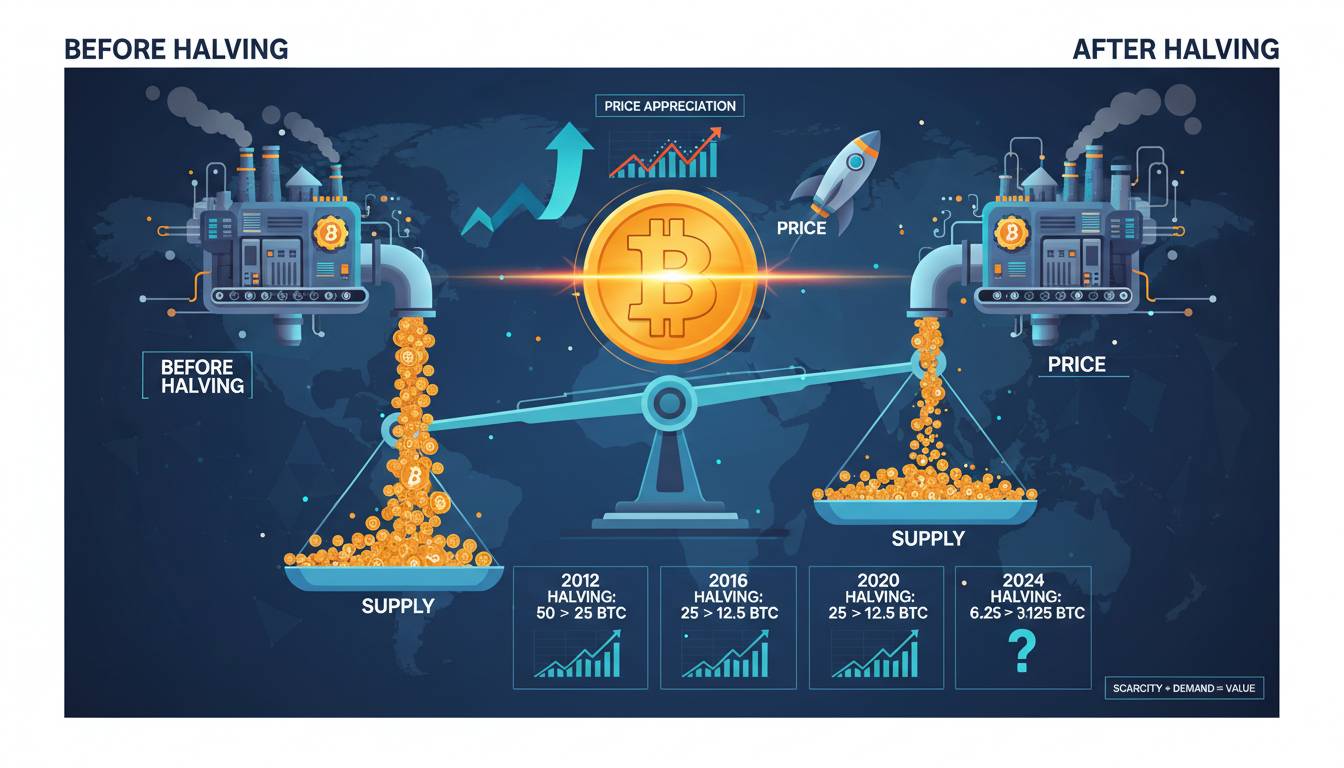
Bitcoin halving is one of the most consequential events in cryptocurrency markets. Roughly every four years, the reward that miners get for validating transactions gets cut in half. It’s programmed into Bitcoin’s code—no one can change it, no one can stop it.
As the next halving approaches, investors and market watchers start asking the same questions: What does this actually mean for price? Why does it matter? And how have previous halvings played out?
This guide breaks it all down.
What Is Bitcoin Halving?
Bitcoin’s creator, Satoshi Nakamoto, built halving directly into the protocol. Every 210,000 blocks—about four years—the block reward gets cut in half. This keeps going until 21 million bitcoins have been mined, which should happen around 2140.
Why does this matter? Three reasons:
- Scarcity. New bitcoins enter circulation slower over time. The supply curve is fixed.
- Deflationary design. Unlike fiat currencies, Bitcoin can’t expand its money supply arbitrarily.
- Predictability. Everyone knows the schedule. No surprises.
Here’s how it’s played out so far:
- 2009: Miners got 50 BTC per block
- 2012: First halving → 25 BTC
- 2016: Second halving → 12.5 BTC
- 2020: Third halving → 6.25 BTC
- 2024: Fourth halving → 3.125 BTC
Each halving means 50% less new supply hitting the market daily.
How It Works Technically
Bitcoin uses proof-of-work. Miners compete to solve math problems, validate transactions, and add blocks to the chain. This takes serious computational power and electricity. The block reward is their incentive.
The halving triggers automatically at specific block heights. There’s no central authority making decisions—code does it. That’s the whole point. No political interference, no printing money.
The catch: when rewards drop, miner profits shrink. Inefficient operations fold. Efficient ones survive and sometimes thrive. This has driven massive innovation in mining hardware—chips keep getting faster and more energy-efficient.
What Happened in Past Halvings
History doesn’t repeat, but it rhymes.
2012: Halving happened when Bitcoin traded under $15. By late 2013, it hit nearly $1,100. A huge run for something most people had never heard of.
2016: Bitcoin was around $650. The next year brought the infamous 2017 bull run—nearly $20,000. This was also when ICOs exploded and mainstream media couldn’t stop talking about crypto.
2020: Halving at roughly $9,000. What followed was the biggest bull cycle yet: Bitcoin peaked near $69,000 in November 2021. Institutions jumped in. MicroStrategy, Tesla, various funds—suddenly Bitcoin was on corporate balance sheets.
2024: Most recent halving, April. Bitcoin was already above $60,000. The market had grown enormously since the previous cycle.
I’ll be honest—the pattern is striking, but causation is tricky to prove. Plenty of other factors drive price: macro conditions, regulatory news, retail sentiment. The halving might create favorable supply dynamics, but it’s not a magic price button.
How Halving Affects Miners
Every halving squeezes miner margins. Revenue drops 50% overnight. Either cut costs or accept lower profits.
This usually means a short-term drop in network hash rate—some miners shut down when they can’t profit anymore. But the network adapts. Difficulty adjusts. More efficient players expand. The ecosystem self-corrects.
There’s an ongoing debate about long-term security. Critics worry that shrinking rewards eventually won’t justify the cost of mining. Supporters point to transaction fees, which rise during busy periods. Eventually, fees might replace block rewards entirely. We’ll see how that plays out.
What Investors Should Consider
Some analysts argue the halving is structurally bullish—less supply flowing into the market, same or growing demand. They’ve got historical evidence. Others caution against oversimplifying. Crypto markets are notoriously unpredictable, and past performance doesn’t guarantee anything.
Institutional investors have grown more interested in Bitcoin. The fixed supply schedule stands in stark contrast to central bank money printing. That “digital gold” narrative resonates with people worried about inflation.
But let’s not forget the risks. Volatility is extreme. Regulations shift. Technology evolves. Macroeconomic forces matter. If you’re investing, understand what you’re getting into.
What’s Coming Next
Eventually, all 21 million bitcoins will be mined. The last halving will reduce the block reward to nearly zero. Mining will persist on fees alone—whether that’s sustainable is still debated.
Technology might change the picture. Better hardware, more renewable energy for mining, layer-two scaling solutions—these could all shift how halving impacts the network. But Bitcoin’s core design has held for over 15 years. It’s weathered plenty of doubters.
Common Questions
What exactly happens during a halving?
The block reward gets cut in half. Less new Bitcoin enters circulation.
How often does it happen?
Every 210,000 blocks, or roughly four years. It’s consistent—built into the code.
Does it always cause price increases?
Past halvings preceded major bull runs, but that’s not a guarantee. Many factors drive price.
When’s the next one?
Around 2028. The block reward drops from 3.125 to 1.5625 BTC. Exact date depends on block times.
How does it affect miners?
Revenue gets cut in half. Inefficient miners may exit. Efficient ones gain share.
Can miners still work after all halvings?
Yes, but they’ll earn transaction fees instead of new coins. The incentive shifts from block rewards to user fees.