
Blockchain is one of the most significant technological innovations of the 21st century. This guide covers what you need to know about blockchain, from basic concepts to real-world applications changing industries.
What is Blockchain?
At its core, blockchain is a distributed digital ledger that records transactions across many computers in a way that makes the records extremely difficult to change retroactively. Each piece of information gets grouped into “blocks,” and these blocks connect chronologically in a “chain.”
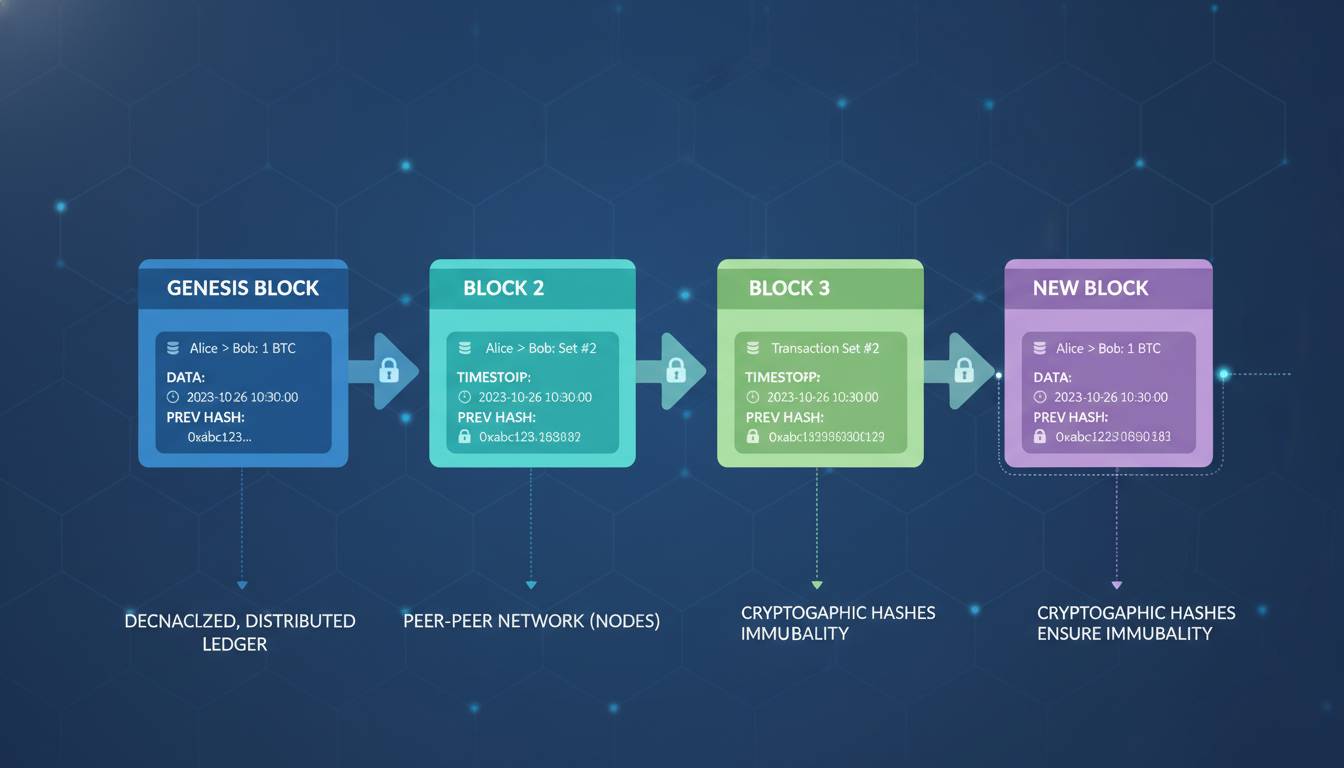
The technology works as a decentralized database that maintains a growing list of records called blocks, linked and secured using cryptography. Each block contains three things: data, a hash of the block, and the hash of the previous block. The hash acts as a digital fingerprint identifying each block, while the connection to the previous block creates the chain structure that makes blockchain secure.
Unlike traditional databases controlled by a single entity like a bank, blockchain operates on a peer-to-peer network where every participant maintains an identical copy of the ledger. This represents a fundamental shift in how digital information gets stored, transferred, and verified.
How Does Blockchain Work?
When someone initiates a transaction — sending cryptocurrency, recording a property transfer, or logging a supply chain event — that transaction gets broadcast to computers called nodes spread across the globe. These nodes validate and record each transaction.
The network of nodes verifies the transaction’s authenticity through consensus. Different blockchains use different consensus mechanisms, with Proof of Work and Proof of Stake being the most common. In Proof of Work systems, miners compete to solve complex mathematical puzzles, and the first to solve it gets to add the new block to the chain. This computational effort makes adding fraudulent blocks require enormous computing power.
Once consensus is reached, the verified transaction gets grouped with other transactions into a new block. This block gets added to the existing chain in chronological order. Once added, changing any information would require changing every subsequent block — a task that becomes computationally infeasible for established blockchains.
Key Characteristics
Several features distinguish blockchain from traditional databases.
Decentralization is the most fundamental characteristic. Rather than storing data in one central location controlled by one authority, blockchain distributes identical copies across thousands of nodes worldwide. This means no single point of failure exists — even if some nodes go offline, the network continues using the remaining ones.
Transparency is another hallmark of public blockchains. Because identical copies exist across all participants, anyone can examine the transaction history. This enables unprecedented auditability, allowing regulators and users to verify transactions independently.
Immutability means once data enters the blockchain, it becomes practically impossible to modify or delete. Each block contains a cryptographic hash from its contents, and because subsequent blocks reference this hash, any attempt to alter historical data breaks the chain’s integrity.
Security emerges from combining cryptographic hashing, distributed consensus, and network decentralization. Each transaction requires digital signatures using public-key cryptography, ensuring only the legitimate owner can authorize transfers.
Types of Blockchain Networks
Several distinct network types exist, each designed for different use cases.
Public blockchains allow anyone to participate without permission. Bitcoin and Ethereum are public blockchains — anyone can become a node, validate transactions, or build applications. These offer maximum decentralization but often sacrifice transaction speed.
Private blockchains restrict participation to approved entities. A single organization controls who can validate transactions and access data. These sacrifice some decentralization but deliver faster processing and greater control.
Hybrid approaches combine elements of both. Federated blockchains operate with a limited number of pre-selected validator nodes while maintaining some public transparency.
Real-World Applications Beyond Cryptocurrency
While cryptocurrency is the most prominent application, blockchain offers transformative potential across many industries.
Supply chain management is promising. Companies can create permanent, transparent records tracking products from raw materials through manufacturing to consumers. Walmart uses blockchain to track produce, reducing the time to trace food sources from days to seconds.
Healthcare uses blockchain’s immutability for secure, interoperable patient records. Medical institutions can share data while maintaining privacy controls and ensuring record integrity.
Voting systems are another application. Blockchain’s transparency and immutability create verifiable audit trails for elections, potentially reducing fraud.
Financial services beyond cryptocurrency also benefit. Cross-border payments, trade finance, identity verification, and asset tokenization all represent areas where blockchain reduces friction, lowers costs, and improves transparency.
Benefits and Limitations
Blockchain has real advantages and genuine limitations.
Benefits include reduced transaction costs by eliminating intermediaries, improved transparency, enhanced security, increased efficiency in settlement processes, and new business models from programmable digital assets.
However, blockchain faces real challenges. Scalability is difficult — achieving consensus across distributed nodes takes longer than centralized operations. Energy consumption in Proof of Work systems has generated environmental concerns. Regulatory uncertainty creates risks. User experience remains confusing for mainstream adoption.
Conclusion
Blockchain is a foundational innovation with implications beyond cryptocurrency speculation. By enabling secure, transparent, and decentralized record-keeping, it addresses long-standing challenges in trust, transparency, and efficiency across industries.
Understanding the fundamentals — distributed ledgers, consensus mechanisms, cryptographic security, and immutability — provides a foundation for evaluating potential applications. While challenges remain around scalability, energy, and regulation, blockchain’s architectural advantages continue driving investment and innovation.
Expect blockchain to integrate more deeply into everyday digital infrastructure, whether through financial services, identity management, or applications not yet imagined.
Frequently Asked Questions
What is blockchain in simple terms?
Blockchain is a digital ledger system that records information across multiple computers, making the records extremely difficult to alter. Think of it as a shared document that thousands of people maintain identical copies of, ensuring no one can secretly change the records.
How does blockchain differ from a traditional database?
Traditional databases store information centrally under one organization’s control, while blockchain distributes copies across thousands of independent computers. Traditional databases allow easy modification, whereas blockchain records become practically immutable once added.
Is blockchain the same as Bitcoin?
No. Bitcoin is a digital currency that uses blockchain as its underlying infrastructure. Blockchain is the broader technology enabling applications beyond cryptocurrency, including supply chain tracking, voting systems, and smart contracts.
What are the main benefits of blockchain?
Key benefits include decentralization eliminating single points of failure, transparency enabling independent verification, immutability ensuring record integrity, enhanced security through cryptography, and reduced reliance on intermediaries potentially lowering costs.
Can blockchain transactions be reversed?
Generally, blockchain transactions are designed to be irreversible once confirmed. This immutability is a core feature, though it creates challenges when errors occur. Some blockchains have mechanisms for dispute resolution in specific circumstances.
What industries benefit most from blockchain?
Industries requiring transparent record-keeping, trust between parties, and reduced intermediary costs benefit significantly. Financial services, supply chain management, healthcare, real estate, and intellectual property management are actively exploring or implementing blockchain solutions.