
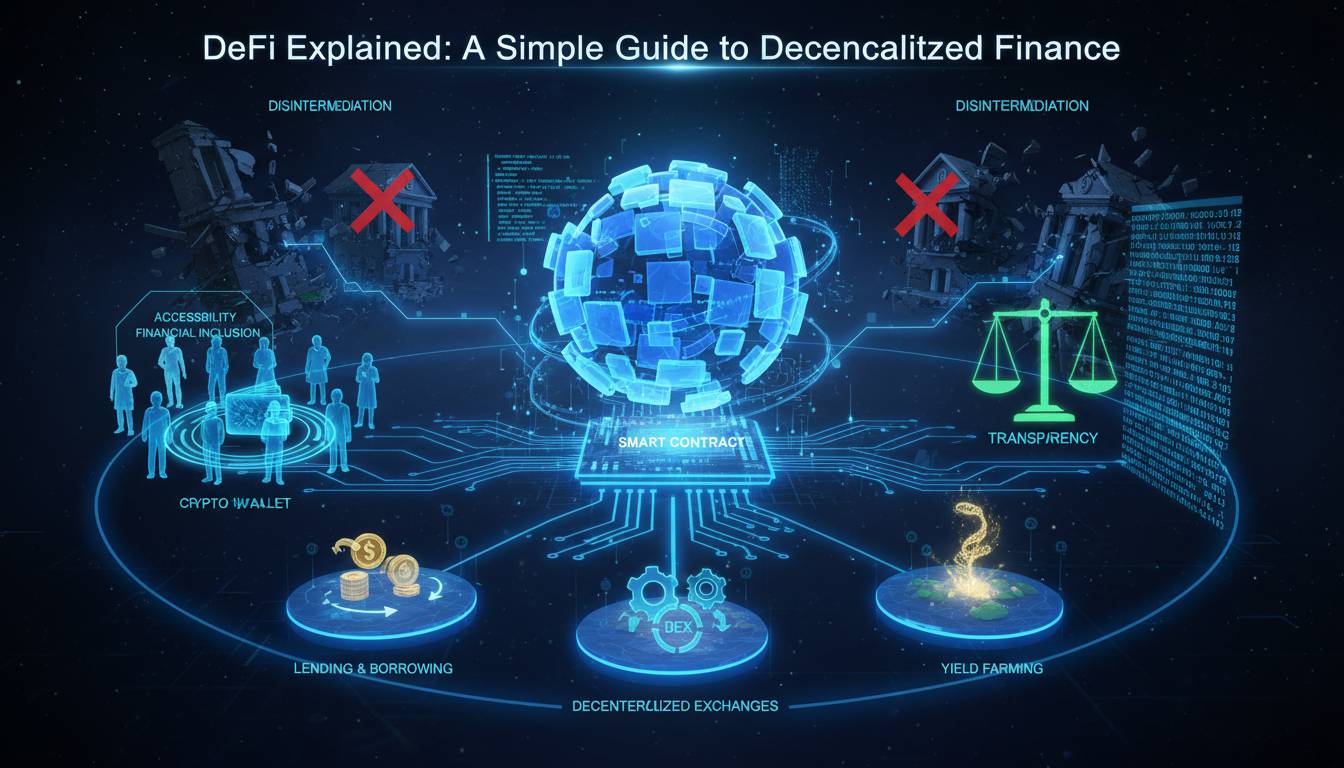
Decentralized Finance, commonly known as DeFi, represents a fundamental shift in how financial services operate. Unlike traditional banking systems that rely on intermediaries like banks, brokers, and clearinghouses, DeFi uses blockchain technology to enable peer-to-peer financial transactions. This transformation allows anyone with an internet connection to access financial services—borrowing, lending, trading, and earning interest—without needing approval from centralized institutions. The DeFi ecosystem has grown from virtually nothing in 2019 to over $50 billion in total value locked by 2021, demonstrating a remarkable acceleration in adoption. This guide breaks down DeFi into digestible concepts, explaining how it works, why it matters, and how you can participate safely.
What is DeFi?
DeFi refers to financial applications built on blockchain networks, primarily Ethereum, that operate without traditional financial intermediaries. These applications use smart contracts—self-executing programs stored on the blockchain that automatically enforce agreements between parties—to replicate traditional financial services like loans, insurance, and trading.
The core philosophy behind DeFi is financial inclusion and transparency. According to the World Bank, approximately 1.4 billion adults globally lack access to traditional banking services. DeFi promises to bridge this gap by providing open, permissionless financial infrastructure that anyone can use. Unlike conventional banks that operate during limited hours and often take days to process transactions, DeFi protocols function 24 hours a day, seven days a week, settling transactions in minutes or seconds.
Traditional finance involves multiple layers of intermediaries, each taking a cut of every transaction. When you transfer money internationally, you might pay fees to your bank, the receiving bank, and intermediary banks along the way. DeFi eliminates most of these middlemen, potentially reducing costs significantly. A 2022 study by the National Bureau of Economic Research found that DeFi transactions can reduce settlement times from days to seconds while cutting transaction costs by up to 90% compared to traditional wire transfers.
How DeFi Works: The Building Blocks
Understanding DeFi requires grasping several technical components that work together to create a decentralized financial system. These building blocks include blockchain networks, smart contracts, oracles, and decentralized exchanges.
Blockchain Networks serve as the foundation. Ethereum remains the dominant platform for DeFi, hosting over 60% of total value locked in the ecosystem as of 2023. Other competing blockchains including Solana, Avalanche, and Polygon have gained significant market share by offering faster transaction speeds and lower fees.
Smart Contracts are the engines of DeFi. These are immutable programs deployed on the blockchain that automatically execute when predefined conditions are met. When you lend your cryptocurrency on a DeFi platform, a smart contract locks your funds and automatically distributes interest to your wallet. There’s no bank officer reviewing your application—no human intervention exists. The code handles everything transparently and verifiably.
Oracles provide external data to smart contracts. Since blockchains cannot access information outside their network natively, oracles like Chainlink feed real-world data—such as asset prices, interest rates, and weather information—into DeFi protocols. This enables functions like setting collateral values for loans based on real-time market prices.
Decentralized Exchanges (DEXs) allow users to trade cryptocurrencies directly from their wallets without depositing funds on a centralized platform. Uniswap, the largest DEX by volume, processed over $1.6 trillion in trading volume from 2020 through 2023. These exchanges use automated market makers (AMMs) instead of traditional order books, enabling continuous liquidity.
| Component | Function | Major Examples |
|---|---|---|
| Blockchain | Underlying ledger | Ethereum, Solana, Polygon |
| Smart Contracts | Auto-executing agreements | OpenZeppelin templates |
| Oracles | External data feeds | Chainlink, Band Protocol |
| DEXs | Peer-to-peer trading | Uniswap, Curve, SushiSwap |
Key DeFi Concepts Explained
Several fundamental concepts form the backbone of the DeFi ecosystem. Understanding these terms helps navigate the space more effectively and make informed financial decisions.
— Bridget (@bridge__harris) February 13, 2025
Total Value Locked (TVL) measures the total amount of cryptocurrency deposited into DeFi protocols. This metric indicates the scale and health of the ecosystem. When TVL peaks above $180 billion in late 2021, it represented massive growth from just $1 billion in 2019. However, the market experienced significant correction, with TVL dropping to approximately $40 billion by late 2023 before recovering.
Yield Farming involves moving cryptocurrency between different DeFi protocols to maximize returns. Users essentially hunt for the highest yields, similar to how investors search for the best interest rates across banks. While yields can appear extraordinarily high—sometimes exceeding 100% annually—these returns often come with substantial risk, including smart contract vulnerabilities and impermanent loss.
Liquidity Provision allows users to supply assets to DEXs, earning fees from traders who use that liquidity. When you provide liquidity to a trading pair, you receive liquidity provider (LP) tokens representing your share. The Uniswap protocol alone has generated hundreds of millions in fees for liquidity providers over the years.
Borrowing and Lending represents one of DeFi’s most practical applications. Platforms like Aave and Compound allow users to deposit cryptocurrency as collateral and borrow other assets. Interest rates are determined algorithmically based on supply and demand—unlike bank loan rates set by executives, these rates adjust in real-time. As of 2023, Aave has facilitated over $30 billion in cumulative loan volume.
Stablecoins are cryptocurrencies designed to maintain a fixed value, typically pegged to the US dollar. They solve cryptocurrency volatility problems, enabling users to hold digital assets without experiencing wild price swings. Tether (USDT) and USD Coin (USDC) together represent over $150 billion in market capitalization, serving as the primary liquidity vehicles for DeFi trading and lending.
Popular DeFi Use Cases
DeFi has moved beyond theoretical possibilities into practical applications serving millions of users. Several use cases demonstrate the real-world utility of decentralized finance.
What defines DeFi (Decentralized Finance)?
Is it a technical definition specific to crypto, or does it include the broader use of decentralized systems in finance?@nestorious828 discussed this and other #DeFi topics at Blockchain Expo last week. pic.twitter.com/4mTnQug2HK
— Stellar (@StellarOrg) November 17, 2019
Decentralized Lending enables uncollateralized or partially collateralized loans. Unlike traditional banks requiring extensive credit checks and documentation, DeFi lending platforms assess borrower risk through overcollateralization. Users can borrow up to a certain percentage of their deposited collateral’s value without undergoing identity verification. This opens credit access to the underbanked while maintaining protocol solvency through excess collateral.
Synthetic Assets represent real-world assets on the blockchain. Platforms like Synthetix allow users to create tokenized versions of stocks, commodities, and currencies. This enables 24/7 trading of traditional financial instruments without the intermediaries typically required. Users can gain exposure to assets like Apple stock or gold directly from their crypto wallets.
Decentralized Insurance provides coverage against smart contract failures and other crypto-specific risks. Protocols like Nexus Mutual allow users to pool resources and insure against risks like exchange hacks or smart contract bugs. This represents an innovative approach to risk management that bypasses traditional insurance companies.
Prediction Markets leverage DeFi infrastructure to create markets on event outcomes. Platforms like Polymarket allow users to trade shares representing different outcomes of real-world events—from election results to sports outcomes. These markets often demonstrate remarkable accuracy in forecasting, sometimes outperforming traditional polling.
| Use Case | Platform | Key Benefit |
|---|---|---|
| Lending | Aave, Compound | Instant loans, algorithmic rates |
| Trading | Uniswap, Curve | No KYC, instant settlement |
| Derivatives | dYdX, GMX | Leveraged trading, perp markets |
| Insurance | Nexus Mutual | Peer-to-peer risk coverage |
Risks and Challenges
While DeFi offers significant advantages, understanding its risks is crucial for anyone participating in the ecosystem. The space remains largely unregulated, and users bear full responsibility for their decisions.
Smart Contract Vulnerabilities represent one of the most significant risks. In 2022 alone, hacks exploited DeFi protocols for approximately $3.8 billion, according to blockchain security firm CertiK. These attacks often target code flaws in smart contracts, draining funds from protocols and their users. The Wormhole bridge hack in February 2022 resulted in $320 million in losses—highlighting the potential scale of vulnerabilities.
Impermanent Loss affects liquidity providers when the price ratio between deposited assets changes. When you provide liquidity to a trading pair, you own a percentage of the pool rather than holding the assets directly. If one asset’s price changes significantly relative to the other, you might have been better off simply holding the assets instead of providing liquidity. This remains a constant risk for yield farmers.
Regulatory Uncertainty creates additional complexity. Governments worldwide are still determining how to regulate DeFi activities. The US Securities and Exchange Commission has indicated that many tokens may qualify as securities, potentially subjecting DeFi protocols to registration requirements. Users could face tax implications, legal challenges, or frozen accounts depending on regulatory developments.
Platform Risk encompasses the possibility that DeFi protocols may fail due to poor design, abandonment, or economic attacks like market manipulation. Even established protocols have faced challenges—Solend, a lending protocol on Solana, faced a crisis in 2022 where a large whale’s position threatened protocol solvency, leading to emergency governance votes to seize control of the account.
Getting Started with DeFi
For those interested in exploring DeFi, a methodical approach helps minimize risks while learning the ecosystem. Starting small and gradually increasing involvement allows users to understand mechanics before committing significant capital.
Setting Up a Wallet represents the first step. A Web3 wallet like MetaMask, Rabby, or Ledger Live enables interaction with DeFi protocols. Users must secure their seed phrase—typically 12 or 24 words—which provides access to their funds. Losing this phrase means permanent loss of all assets; sharing it means instant theft.
Acquiring Base Assets comes next. Most DeFi interactions require Ethereum (ETH) or other blockchain tokens for transaction fees. Centralized exchanges like Coinbase or Kraken facilitate purchasing cryptocurrency with traditional currency. Users should only purchase from reputable exchanges and transfer to personal wallets rather than leaving funds on exchanges.
Connecting to Protocols involves linking your wallet to DeFi applications through a process typically labeled “Connect Wallet.” This creates a secure connection without revealing private keys. Once connected, users can interact with the full suite of DeFi functions—swapping tokens, providing liquidity, or borrowing against collateral.
Starting with Low-Risk Activities helps build familiarity. Providing liquidity to stablecoin pools, where impermanent loss risk is minimal, allows users to earn yields while learning platform interfaces. Many protocols also offer “testnet” versions where users can practice with fake currency before risking real assets.
The Future of Decentralized Finance
The trajectory of DeFi suggests continued evolution and integration with traditional finance. Several trends are shaping the ecosystem’s future.
Institutional Adoption is accelerating. Major financial institutions including JPMorgan, Goldman Sachs, and Fidelity have explored or launched DeFi-related services. BlackRock, the world’s largest asset manager, has shown interest in blockchain technology, signaling potential for mainstream capital entry.
Regulatory Clarity is expected to emerge, potentially providing more structure for DeFi operations while protecting consumers. The European Union’s MiCA (Markets in Crypto-Assets) regulation, taking full effect in 2024, represents one of the most comprehensive frameworks globally. The US is likely to develop its own regulatory approach over the coming years.
Cross-Chain Interoperability continues improving, enabling assets and information to flow between different blockchain networks. Protocols like LayerZero and Axelar facilitate communication between chains, potentially creating a more unified DeFi ecosystem. This development could significantly expand the可用 liquidity and users across the space.
Real-World Asset Tokenization represents a growing trend, with traditional assets like real estate, stocks, and commodities being represented on-chain. This could bring trillions of dollars in traditional assets into DeFi, dramatically expanding the ecosystem’s scale and utility.
The convergence of these trends suggests DeFi will play an increasingly important role in global finance. While risks remain and challenges persist, the fundamental promise—financial services accessible to anyone with an internet connection—continues driving innovation and adoption.
Frequently Asked Questions
What is the difference between DeFi and traditional finance?
Traditional finance relies on centralized intermediaries like banks, brokerages, and clearinghouses to facilitate transactions. DeFi replaces these intermediaries with smart contracts operating on blockchains. This means DeFi typically offers 24/7 availability, faster transaction settlement, lower fees, and open access to anyone with an internet connection. However, traditional finance provides regulatory protection, customer service, and established trust mechanisms that DeFi currently lacks.
Is DeFi safe to use?
DeFi carries significant risks including smart contract vulnerabilities, which have resulted in billions of dollars in hacks. Users should only invest what they can afford to lose, start with small amounts while learning, use hardware wallets for large holdings, and research protocols thoroughly before committing funds. No FDIC insurance or regulatory protections cover DeFi losses.
How do you make money with DeFi?
Primary income sources include lending interest (earning yield by supplying assets to lending protocols), liquidity provision (earning trading fees by supplying liquidity to DEXs), yield farming (moving funds between protocols to chase higher yields), and governance token rewards (receiving free tokens for participating in DeFi protocols). However, all strategies carry risks including loss of principal.
Do I need a lot of money to start with DeFi?
No, you can start with minimal amounts. Many DeFi protocols have no minimum deposit requirements. However, you should account for transaction fees (called “gas” on Ethereum), which can be significant during network congestion. Some users start with $100-500 to learn the mechanics before committing larger amounts.
What happens if I lose my wallet or seed phrase?
If you lose your wallet file but have your seed phrase, you can restore access by importing the seed phrase into a new wallet application. If you lose your seed phrase, your funds are permanently inaccessible—there is no password reset or customer support to recover them. This is why secure backup of seed phrases is absolutely critical in DeFi.