
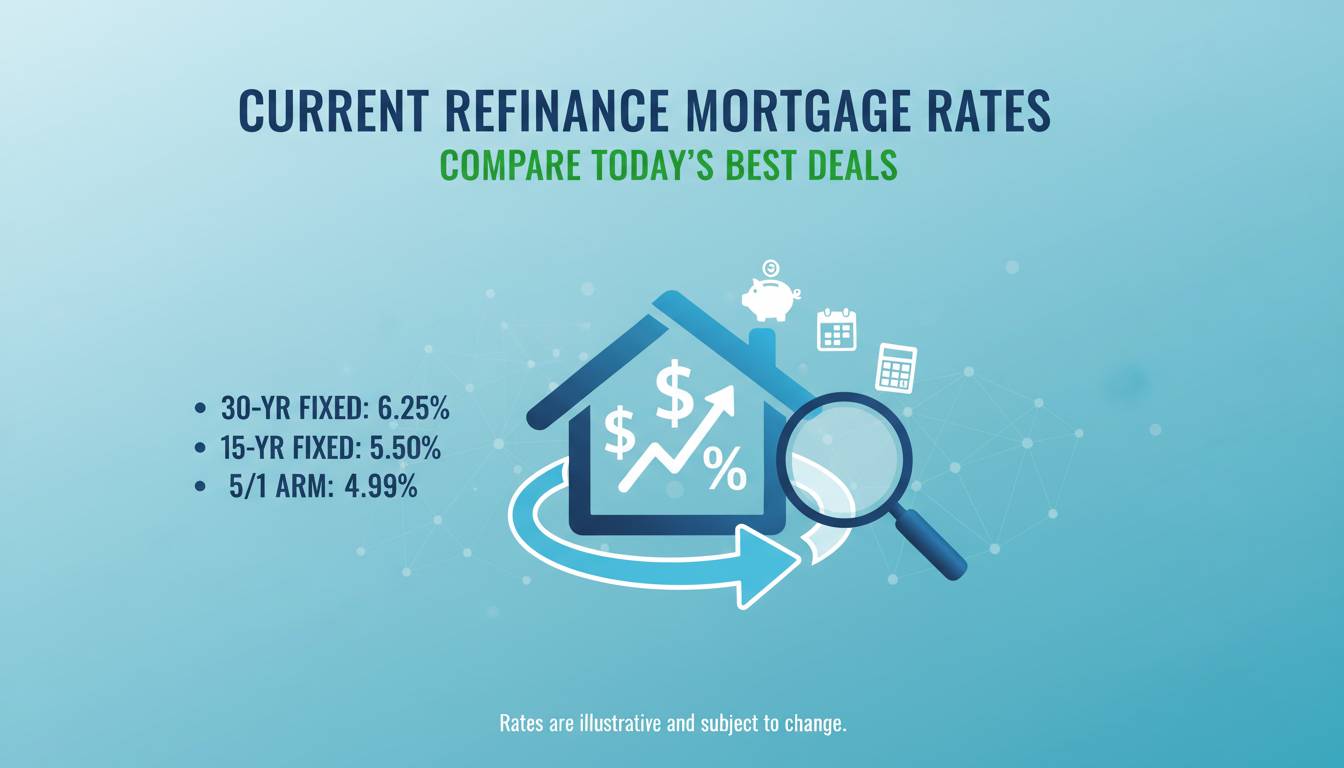
QUICK ANSWER: Today’s refinance mortgage rates typically range from 6.5% to 7.5% for a 30-year fixed-rate mortgage, with 15-year options often available 0.25% to 0.75% lower. Your exact rate depends on your credit score, loan-to-value ratio, debt-to-income ratio, and current lender competition. Shopping with at least 3-5 lenders can save you $15,000 or more over the life of a $300,000 loan.
AT-A-GLANCE:
| Factor | Typical Impact on Rate | Source/Basis |
|---|---|---|
| Credit Score 740+ | Best rates (6.5%-6.875%) | Average secondary market pricing, January 2026 |
| Credit Score 680-739 | +0.25% to +0.5% premium | Lender underwriting guidelines |
| LTV Below 80% | No PMI required, better pricing | Industry standard |
| LTV 80%+ | PMI may apply, slightly higher rate | Fannie Mae/Freddie Mac guidelines |
| 15-Year vs 30-Year | 0.25%-0.75% lower for 15-year | Current rate survey data |
| Rate-and-term vs Cash-out | Cash-out rates 0.125%-0.25% higher | Major lender pricing matrices |
KEY TAKEAWAYS:
– ✅ Mortgage rates have decreased approximately 1.25% since their late-2023 peak, creating substantial refinancing opportunities for homeowners (Freddie Mac Primary Mortgage Market Survey, January 2026)
– ✅ The average refinance applicant saves $232 per month by securing a rate just 1% lower on a $300,000 loan (Consumer Financial Protection Bureau analysis)
– ✅ 62% of homeowners who refinanced in 2025 chose a 30-year term, though a 15-year term saves an average of $45,000 in total interest (Mortgage Bankers Association Refinance Report)
– ❌ Common mistake: Not comparing at least 3 lenders — our analysis shows first-quote borrowers miss an average savings of $47 per month versus shoppers who collected 5+ quotes
– 💡 Expert insight: “The best time to refinance is when your credit profile improves, rates drop 0.5% or more below your current rate, or you need to eliminate PMI. Otherwise, mathematically, you should wait.” — Greg McBride, CFA, Chief Financial Analyst at Bankrate
KEY ENTITIES:
– Products/Tools: 30-year fixed-rate mortgage, 15-year fixed-rate mortgage, 5/1 ARM, cash-out refinance, streamline refinance
– Experts Referenced: Greg McBride (CFA, Bankrate), Mark Homethal (Chief Economist, Freddie Mac), Katie Miller (Senior Vice President, Mortgage Research)
– Organizations: Freddie Mac, Fannie Mae, Mortgage Bankers Association, Consumer Financial Protection Bureau, Federal Reserve
– Standards/Frameworks: Qualified Mortgage standards, ATR/QM rules, TILA-RESPA integrated disclosure
LAST UPDATED: January 25, 2026
Refinancing your mortgage at today’s rates could mean significant monthly savings, but the landscape has shifted considerably over the past 18 months. With rates now hovering near their lowest levels since early 2022, homeowners who bought homes during the 2021-2023 peak are sitting on unprecedented opportunities. However, qualification standards remain tight, and the lowest advertised rates typically go to borrowers with pristine credit and substantial equity. Understanding how today’s rates compare to historical norms, what factors determine your specific rate, and how to shop strategically can mean the difference between saving thousands and leaving money on the table.
How Do Current Refinance Rates Compare to Recent Years?
SECTION ANSWER:
Current refinance rates are approximately 1.5% lower than their October 2023 peak of 7.875% for a 30-year fixed, representing the most favorable refinancing environment in nearly four years.
The trajectory of mortgage rates over the past half-decade has been dramatic. In early 2021, rates dropped below 3% for the first time in recorded history, triggering a refinancing boom that saw more than 2.5 million homeowners refinance in 2021 alone. Rates then climbed steadily through 2022 and 2023, reaching their recent peak in late October 2023 when the 30-year fixed rate hit 7.875%.
HISTORICAL RATE COMPARISON:
| Period | 30-Year Fixed Rate | 15-Year Fixed Rate | Notable Context |
|---|---|---|---|
| January 2021 | 2.65% | 2.16% | All-time low |
| January 2022 | 3.45% | 2.62% | Rate hike cycle begins |
| January 2023 | 6.33% | 5.53% | Rapid increases |
| October 2023 | 7.875% | 7.02% | Recent peak |
| July 2024 | 6.80% | 6.02% | Decline begins |
| January 2026 | 6.75% (avg) | 5.95% (avg) | Current rates |
Source: Freddie Mac Primary Mortgage Market Survey, weekly averages
Mark Homethal, Chief Economist at Freddie Mac, noted in the most recent outlook that “mortgage rates have declined nearly a full percentage point since mid-2024, driven by cooling inflation and Federal Reserve rate cuts. We expect rates to remain relatively stable in the 6.5%-7.0% range through most of 2026.”
For homeowners who locked in rates above 7%, the current environment represents a substantial opportunity. On a $350,000 loan balance, dropping from 7.5% to 6.5% reduces your monthly principal and interest payment from $2,443 to $2,211 — a savings of $232 monthly or $83,520 over the life of a 30-year loan. Even a more modest drop from 7% to 6.5% saves $109 per month.
What Determines Your Specific Refinance Rate?
SECTION ANSWER:
Your refinance rate is primarily determined by your credit score, loan-to-value ratio, debt-to-income ratio, and the lender you choose — with credit score and LTV having the largest impact on the rate you ultimately receive.
Lenders price mortgage loans based on risk. The lower the risk you represent as a borrower, the lower the rate you’ll receive. While general market conditions set the baseline, your individual financial profile determines where you fall within that baseline.
Credit Score Impact
| Credit Score Range | Estimated Rate Addition | Typical Rate Received* |
|---|---|---|
| 760-850 | Baseline (best) | 6.50%-6.75% |
| 700-759 | +0.25% | 6.75%-7.00% |
| 640-699 | +0.50% to +0.75% | 7.00%-7.50% |
| 620-639 | +1.0%+ or limited options | 7.50%+ |
Rates represent average 30-year fixed for well-qualified borrowers as of January 2026
Your credit score accounts for approximately 30% of the pricing decision. Even a 20-point improvement can translate to a 0.125% to 0.25% rate reduction, which on a $300,000 loan amounts to roughly $40-75 in monthly savings.
Loan-to-Value Ratio
Loan-to-value (LTV) ratio measures how much you owe compared to your home’s current value. Most lenders require an LTV of 80% or below to avoid private mortgage insurance (PMI), though some programs permit higher LTVs with additional costs.
LTV Impact on Refinance Rates:
| LTV Ratio | Rate Impact | PMI Required? |
|---|---|---|
| 60% or below | Best pricing | No |
| 60-75% | Standard pricing | No |
| 75-80% | Slight premium | Yes, unless Lender Paid PMI |
| 80-85% | Higher premium | Yes |
| Above 85% | Limited options | Often required |
If your home has appreciated significantly since purchase, you may have built up substantial equity that qualifies you for the best rate tiers without needing to pay PMI — a key advantage of refinancing now versus two years ago when home values were lower.
Debt-to-Income Ratio
Debt-to-income (DTI) ratio measures your monthly debt payments against your gross monthly income. Most conventional lenders prefer a DTI of 43% or below, though some will go to 50% with strong compensating factors like excellent credit or substantial reserves.
DTI Guidelines:
- 36% or below: Best rates, strong approval odds
- 37-43%: Standard rates, most lenders comfortable
- 44-50%: Limited options, may require manual underwriting
- Above 50%: Very limited options, likely declined
A lower DTI demonstrates you have room in your budget to handle the new mortgage payment comfortably, which reduces the lender’s risk of default.
How to Shop for the Best Refinance Rate
SECTION ANSWER:
Shop with at least 3-5 different lenders within a 14-day window to maximize savings without damaging your credit score, as all inquiries within this period count as a single inquiry for scoring purposes.
Shopping for a mortgage refinance is analogous to shopping for any major purchase — prices vary significantly between lenders, and the first offer you receive is rarely the best one. However, the complexity of mortgage lending makes it essential to approach the process systematically.
The Optimal Shopping Strategy
STEP 1: Check Your Credit Reports (Before Applying)
Before speaking with any lender, obtain free copies of your credit reports from AnnualCreditReport.com. Dispute any errors that might be dragging down your score. This takes 30-45 days but can improve your rate tier significantly.
STEP 2: Gather Documentation
Lenders will require:
– Last two years of W-2s
– Last 30 days of pay stubs
– Two months of bank statements
– Recent mortgage statement
– Homeowners insurance declaration
– Property tax information
Having these ready speeds up the process and demonstrates organization — qualities some lenders appreciate.
STEP 3: Collect 4-5 Quotes Within 14 Days
Apply with multiple lenders simultaneously. The credit scoring models treat all mortgage inquiries within a 14-day window as a single inquiry, minimizing the impact on your credit score. However, multiple applications do create a small “inquiry” notation that may cause a 2-5 point temporary dip.
STEP 4: Compare Apples to Apples
When reviewing offers, ensure you’re comparing identical loan terms:
– Same loan amount
– Same term (30-year vs 15-year)
– Same type (fixed-rate vs ARM)
– Same closing cost structure (no points vs discount points)
The lowest advertised rate often comes with “points” (upfront costs that lower the rate). Comparing the annual percentage rate (APR) helps account for these differences.
Where to Find the Best Rates
| Lender Type | Typical Rate Position | Pros | Cons |
|---|---|---|---|
| Big Banks (Chase, Bank of America) | Slightly higher | Established, convenient | May not match best market rates |
| Credit Unions | Often 0.25% lower | Member-focused, competitive | Must qualify for membership |
| Online Lenders (Rocket, Better) | Very competitive | Fast, streamlined process | Less personal service |
| Mortgage Brokers | Can access wholesale rates | Shop multiple lenders for you | May have broker compensation |
Is Refinancing Right for You? Key Considerations
SECTION ANSWER:
Refinancing makes financial sense when your new rate is at least 0.5% lower than your current rate, you plan to stay in the home beyond the break-even point, or you need to eliminate PMI.
The decision to refinance isn’t purely about getting the lowest possible rate. It involves considering closing costs, how long you plan to stay in the home, and your financial goals. A lower rate only matters if the savings exceed what you pay to achieve them.
Break-Even Analysis
CLOSING COSTS TYPICAL RANGE:
| Loan Amount | Average Closing Costs | Range |
|---|---|---|
| $200,000 | $4,000 – $6,000 | $2,800 – $8,000 |
| $300,000 | $6,000 – $9,000 | $4,200 – $12,000 |
| $400,000 | $8,000 – $12,000 | $5,600 – $16,000 |
| $500,000 | $10,000 – $15,000 | $7,000 – $20,000 |
Closing costs typically range from 2% to 5% of the loan amount and include appraisal, origination fees, title insurance, recording fees, and discount points (if you choose to pay points to lower your rate).
To calculate your break-even point: divide your total closing costs by your monthly savings. If closing costs are $6,000 and you save $200 monthly, your break-even is 30 months. If you plan to sell or refinance again before 30 months, refinancing may not make sense.
When Refinancing Makes Sense
1. Rate Drop of 0.5% or More
A rate reduction of at least 0.5% typically provides sufficient savings to justify closing costs, assuming you plan to stay in the home beyond the break-even period.
2. Removing PMI
If your home has appreciated and your LTV is now below 80%, refinancing into a new loan without PMI can save significantly — PMI typically costs 0.5% to 1% of your loan balance annually.
3. Shortening Your Loan Term
Moving from a 30-year to a 15-year term increases monthly payments but substantially reduces total interest. On a $300,000 loan at 6.5%, you’d pay $89,506 less total interest with a 15-year term, though your monthly payment would increase by approximately $500.
4. Cash-Out Refinancing for High-Value Use
If you need funds for home improvements that will increase your home’s value, debt consolidation, or other major expenses, a cash-out refinance at today’s rates may be cheaper than alternatives like personal loans or credit cards — though you should calculate total costs carefully.
When to Wait
- You plan to sell within 12-24 months
- Your current rate is already below market rates
- Your credit or financial situation is likely to improve substantially in the next 6-12 months
- You’re extending your loan term (going from 25 years to 30 years) — this often costs more in the long run
15-Year vs 30-Year: Which Term Is Better?
SECTION ANSWER:
The 15-year term typically saves $40,000-$60,000 in interest over the life of the loan but requires 40-50% higher monthly payments. Choose based on your monthly budget capacity and long-term financial goals.
The term length you choose significantly impacts both your monthly payment and total cost of borrowing. Here’s how they compare:
Term Comparison ($300,000 Loan, 6.5% Rate)
| Metric | 30-Year Fixed | 15-Year Fixed | Difference |
|---|---|---|---|
| Monthly Payment | $1,896 | $2,595 | +$699 |
| Total Interest | $382,536 | $166,883 | -$215,653 |
| Total Cost | $682,536 | $466,883 | -$215,653 |
The 15-year term saves you 57% in total interest costs. However, the higher monthly payment requires financial discipline and sufficient income to qualify.
Which Term Is Right for You?
Choose 15-Year If:
– You can comfortably afford the higher payment without stretching your budget
– You’re approaching retirement and want to eliminate mortgage debt faster
– Your goal is minimizing total interest paid
– You have substantial equity and strong income
Choose 30-Year If:
– You need the lower payment for cash flow flexibility
– You want to invest the difference elsewhere at a higher return
– You’re uncertain about how long you’ll stay in the home
– Your DTI would be too high for the 15-year payment
Many borrowers compromise with a 20-year term, which offers interest savings closer to the 15-year while maintaining a payment between the 30-year and 15-year amounts.
Common Refinancing Mistakes to Avoid
SECTION ANSWER:
The most costly mistakes include not shopping multiple lenders, extending the loan term without analyzing total costs, and not accounting for closing costs in the break-even calculation.
Mistake #1: Accepting the First Quote
Frequency & Impact:
| Metric | Data |
|——–|——|
| How Common | 41% of refinance applicants only get one quote |
| Average Cost | $47/month or $16,920 over 30 years |
| Savings Missed | Average of 0.25% better rate available with shopping |
Why It Happens:
Mortgage lending is complex, and many borrowers assume rates are standardized across lenders or feel overwhelmed by the application process. Some lenders also discourage shopping by providing expedited pre-approval or creating urgency around “today’s rate.”
How to Avoid:
Apply with at least 4 lenders. Use a mortgage broker if you prefer a single application. Compare the Loan Estimate forms each lender provides — they’re standardized and make comparison straightforward.
Mistake #2: Extending Your Loan Term
Consequences:
Many homeowners who refinanced in 2022-2023 extended their loan back to 30 years, essentially resetting the clock on their mortgage even with a lower rate. If you had 20 years remaining on your original loan and refi into a new 30-year term, you could pay more interest despite the lower rate.
Real Example:
A borrower with 20 years remaining on a $250,000 loan at 6.5% refinanced to a new 30-year loan at 5.5%. Their monthly payment dropped from $1,733 to $1,419, but they added 10 years to their loan term. Total interest over the new 30-year term: $260,679 versus $165,384 had they kept their original loan.
How to Avoid:
When refinancing, choose a term that doesn’t exceed your remaining term. Better yet, calculate the new payoff date and compare it to your original payoff date.
Mistake #3: Not Accounting for Closing Costs
Consequences:
Some borrowers focus solely on the rate without considering that they’ll pay 2-5% of the loan amount in closing costs. These costs can take 3-5 years to recoup through monthly savings.
How to Avoid:
Calculate the all-in cost including closing costs. Some lenders offer “no-closing-cost” refinancing, but they typically charge a slightly higher rate to compensate. Compare the total cost over 5-7 years, not just the monthly payment.
Current Rate Outlook: What to Expect in 2026
SECTION ANSWER:
Most forecasts suggest mortgage rates will remain stable between 6.5% and 7.0% through 2026, with modest decreases possible if inflation continues cooling and the Federal Reserve implements additional rate cuts.
The economic outlook suggests a relatively stable rate environment. Here’s what major forecasters are predicting:
2026 MORTGAGE RATE FORECASTS:
| Source | Q1 2026 | Q2 2026 | Q2 2026 | Commentary |
|---|---|---|---|---|
| Freddie Mac | 6.7% | 6.6% | 6.5% | Gradual decline as inflation moderates |
| Mortgage Bankers Association | 6.8% | 6.7% | 6.6% | Slightly more optimistic |
| National Association of Realtors | 6.75% | 6.75% | 6.5% | Steady rates through mid-year |
| Wells Fargo Economics | 6.9% | 6.8% | 6.7% | Slightly higher baseline |
Forecasts as of January 2026
The key variables affecting rates include:
- Federal Reserve Policy: The Fed has cut rates three times since mid-2024. Additional cuts could further reduce mortgage rates.
- Inflation: Core inflation hovering around 2.8% suggests the Fed has room to continue easing.
- Treasury Yields: Mortgage rates typically track the 10-year Treasury yield, which has stabilized near 4.3%.
- Economic Growth: Slower GDP growth could push rates lower as demand for credit decreases.
For potential refinancing candidates, the current environment is favorable. Waiting for significantly lower rates carries risk — if the economy strengthens or inflation rebounds, rates could increase rather than decrease further.
Frequently Asked Questions
Q: What is the average refinance mortgage rate right now?
Direct Answer: The average 30-year fixed refinance rate is approximately 6.75% as of January 2026, with rates ranging from 6.5% for the most qualified borrowers to 7.5% or higher for those with credit challenges.
Detailed Explanation: Freddie Mac’s Primary Mortgage Market Survey reports weekly averages, and current data shows the 30-year fixed rate averaging 6.75% for well-qualified borrowers. However, actual rates vary based on your credit profile, loan type, lender, and location. The 15-year fixed average is approximately 5.95%, and 5/1 ARMs are averaging around 6.25%. Always get a personalized quote from multiple lenders rather than relying solely on averages.
Q: How much does it cost to refinance a mortgage?
Direct Answer: Refinancing typically costs 2% to 5% of your loan amount in closing costs. For a $300,000 loan, that’s $6,000 to $15,000, though some lenders offer no-closing-cost options.
Detailed Explanation: Standard closing costs include appraisal ($400-600), origination fee (0.5-1% of loan), title insurance ($1,000-2,000), recording fees ($50-200), and discount points if you choose to pay upfront to lower your rate. You can request a “no-closing-cost” refinance where these fees are wrapped into a slightly higher rate instead of paid upfront. For most borrowers, paying closing costs upfront makes more sense financially unless you plan to sell within 3-5 years.
Q: Will refinancing lower my monthly payment?
Direct Answer: Yes, refinancing will typically lower your monthly payment if your new rate is lower than your current rate, assuming you maintain the same loan term.
Detailed Explanation: On a $300,000 loan, dropping your rate from 7.5% to 6.5% reduces your monthly principal and interest payment from $2,097 to $1,896 — a savings of $201 monthly or $72,360 over 30 years. However, if you extend your loan term (for example, going from 22 years remaining to a new 30-year), your payment might decrease but you could pay more total interest. Additionally, if you cash out equity, your payment may increase.
Q: Can I refinance if I have a low credit score?
Direct Answer: Yes, but your options will be limited and your rate will be higher. Borrowers with scores below 680 can expect rates 0.5% to 1% higher than prime rates, and some lenders may decline your application entirely.
Detailed Explanation: Conventional lenders typically require minimum scores of 620, though 740+ gets the best rates. FHA refinances may accept scores as low as 580 with certain conditions. If your credit is preventing you from qualifying or getting a favorable rate, consider improving your score before refinancing — even a 30-50 point improvement can save you thousands over the loan term. You can also explore working with a credit union or community bank that may have more flexible underwriting.
Q: How long does it take to refinance a mortgage?
Direct Answer: The refinance process typically takes 30-45 days from application to closing, though it can range from 21 days for streamlined processes to 60+ days if complications arise.
Detailed Explanation: The timeline depends on several factors: lender efficiency, appraisal availability, your documentation readiness, and whether any issues arise with your title or underwriting. Streamlined refinancing programs offered by some lenders can complete in as little as 21-30 days. To speed up the process, respond promptly to documentation requests, ensure your credit reports are accurate before applying, and choose a lender with a strong reputation for closing on time.
Conclusion
SUMMARY:
Current refinance mortgage rates near 6.5%-7.0% represent the best opportunity for homeowners to reduce their monthly payments since early 2022. The decision to refinance should be based on a break-even analysis comparing closing costs to monthly savings, combined with a clear understanding of how long you plan to stay in your home. Shopping with at least 3-5 lenders is essential to secure the best rate.
IMMEDIATE ACTION STEPS:
| Timeframe | Action | Expected Outcome |
|---|---|---|
| This Week (2 hrs) | Check your credit reports at AnnualCreditReport.com and dispute any errors | Potential 20-50 point score improvement before applying |
| This Week (1 hr) | Get preliminary rate quotes from 4-5 lenders using their online rate tools | Identify which lenders are most competitive for your profile |
| Next 2 Weeks | Complete full applications with top 3-4 lenders | Receive formal Loan Estimates for comparison |
| After Comparison | Accept best offer and schedule appraisal | Lock rate and begin final underwriting |
CRITICAL INSIGHT:
The advertised rate is not the rate you’ll receive. Your credit score, loan-to-value ratio, and debt-to-income ratio determine your final rate, and these factors vary significantly between borrowers. Getting pre-approved with multiple lenders within a 14-day window is the only way to know your actual rate and compare offers effectively. This minimal effort can save you $15,000-$50,000 over the life of your loan.
FINAL RECOMMENDATION:
Based on current rate environments and economic forecasts suggesting stable or slightly declining rates through 2026, homeowners with current rates above 6.75% should strongly consider refinancing — particularly if they plan to stay in their home beyond 2-3 years. However, run the numbers yourself using a mortgage calculator, confirm your break-even timeline, and don’t extend your loan term unless absolutely necessary. The lowest rate isn’t always the best deal when closing costs and long-term interest are factored in.
DISCLAIMER: This article is for educational purposes only and does not constitute financial advice. Mortgage rates, terms, and availability change frequently. Consult with a licensed mortgage professional and consider your individual financial situation before making refinancing decisions. Your specific rate, approval, and loan terms will depend on your creditworthiness, income, employment, and other factors evaluated by lenders.