
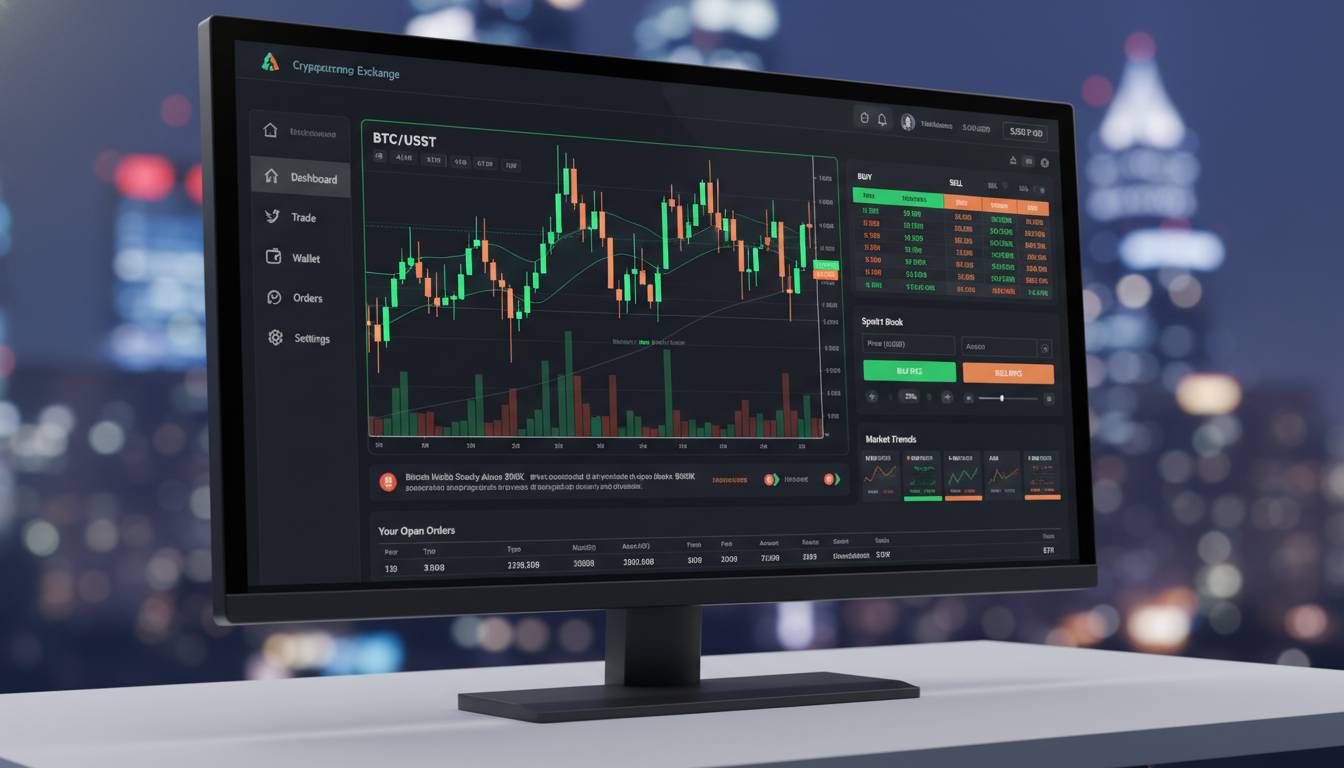
The cryptocurrency market has transformed from a niche experiment into a global financial phenomenon worth over $1 trillion. For beginners, this presents both incredible opportunities and significant risks. Understanding how to navigate this volatile market is essential before investing your first dollar.
This guide breaks down everything you need to know to start trading cryptocurrency responsibly, from choosing your first exchange to executing your initial trade with confidence.
Understanding the Cryptocurrency Market
Cryptocurrency operates on blockchain technology, which is a decentralized digital ledger that records transactions across many computers. Unlike traditional currencies issued by governments (like the US Dollar), cryptocurrencies are typically not controlled by any central authority.
The market operates 24 hours a day, seven days a week, unlike stock markets that close on weekends and holidays. This continuous trading creates both opportunities and challenges for beginners. Prices can move dramatically in either direction within hours, making risk management critically important.
Bitcoin remains the largest cryptocurrency by market capitalization, often serving as a benchmark for the entire market. When Bitcoin rises, many altcoins tend to follow. When it falls, the effect often ripples throughout the market. Understanding this correlation helps beginners make more informed decisions.
Ethereum, the second-largest cryptocurrency, introduced smart contracts—self-executing agreements that have enabled thousands of decentralized applications. Other notable cryptocurrencies include Solana, Cardano, and Ripple, each offering different technological approaches and use cases.
Choosing Your First Crypto Exchange
Selecting the right cryptocurrency exchange is one of the most important decisions you’ll make as a beginner. The exchange you choose affects everything from security to available trading pairs to fees.
Coinbase is widely considered one of the most beginner-friendly exchanges in the United States. It offers an intuitive interface, strong security features, and insurance protection for digital assets held in storage. The platform supports major cryptocurrencies and provides educational resources that reward users with small amounts of crypto for learning about different coins.
Binance.US offers lower fees and a wider selection of trading pairs, making it attractive once you’ve moved past the basics. However, its interface can be more complex for complete beginners. Kraken is known for strong security and lower fees than Coinbase, though its user interface requires a steeper learning curve.
When evaluating exchanges, consider these factors: security track record, fee structures, supported cryptocurrencies, ease of withdrawal, and whether the platform is licensed to operate in your state. Most major exchanges restrict certain states due to regulatory differences, so verify availability before creating an account.
Setting Up Your Trading Account
Once you’ve chosen an exchange, the account setup process typically takes 10-30 minutes. You’ll need to provide identification documents as part of Know Your Customer (KYC) requirements, which are mandatory for regulated exchanges in the United States.
The verification process usually requires a government-issued ID, proof of address, and sometimes a selfie or video verification. This process helps prevent fraud and ensures compliance with anti-money laundering regulations. While it may feel intrusive, these measures exist to protect both you and the platform.
After verification, you’ll need to fund your account. Most exchanges accept bank transfers, which typically take 3-5 business days, or debit card purchases, which process immediately but often come with higher fees. Some exchanges also accept wire transfers for larger amounts.
Before making your first trade, enable two-factor authentication (2FA) on your account. This security measure requires a second form of verification beyond your password, dramatically reducing the risk of unauthorized access. I strongly recommend using an authenticator app rather than SMS-based 2FA, as SIM-swapping attacks have compromised many cryptocurrency accounts.
Fundamental Analysis: How to Evaluate Cryptocurrencies
Before buying any cryptocurrency, you need to understand what you’re investing in. Fundamental analysis examines the underlying factors that might influence a cryptocurrency’s value over time.
Start by reading the whitepaper—the technical document that explains the cryptocurrency’s purpose, technology, and roadmap. Bitcoin’s whitepaper, published in 2008 by the anonymous Satoshi Nakamoto, outlines a peer-to-peer electronic cash system. Ethereum’s whitepaper describes its vision for decentralized applications and smart contracts.
Evaluate the development team behind the project. Look for team members with relevant technical experience, previous successful projects, and transparent identities. Anonymous teams aren’t necessarily problematic, but they do require extra due diligence.
Consider the cryptocurrency’s real-world utility and adoption. Cryptocurrencies that solve actual problems and have growing ecosystems of users and developers tend to have stronger long-term potential than those that exist primarily for speculation.
Tokenomics—the economic structure of a cryptocurrency—matters significantly. Examine the total supply, circulating supply, inflation rate, and how new tokens are created and distributed. Bitcoin’s capped supply of 21 million coins creates inherent scarcity, while some tokens have unlimited supply that can dilute value over time.
Technical Analysis Basics
While fundamental analysis helps you choose what to buy, technical analysis helps you determine when to buy it. Technical analysis involves reading price charts and identifying patterns that might predict future price movements.
Candlestick charts are the most common tool for visualizing price movements. Each candlestick shows the open, high, low, and close prices for a specific time period. Green (or white) candles indicate price increases, while red (or black) candles show decreases.
Support and resistance levels are price points where buying or selling pressure tends to emerge. When a cryptocurrency repeatedly fails to fall below a certain price, that level becomes support. When it repeatedly struggles to exceed a certain price, that level becomes resistance. Breaking through these levels often triggers significant price movements.
Moving averages smooth out price data to reveal trends. The 50-day and 200-day moving averages are particularly popular. When the 50-day crosses above the 200-day, traders call this a “golden cross”—traditionally a bullish signal. The opposite, a “death cross,” is considered bearish.
Volume—the number of tokens traded during a given period—confirms price movements. Significant price changes accompanied by high volume are more likely to sustain than those with low volume.
Risk Management Strategies
The cryptocurrency market is notoriously volatile, and many beginners lose money because they fail to manage risk properly. Implementing solid risk management strategies is essential for long-term success.
Never invest more than you can afford to lose. This isn’t just advice—it’s a fundamental principle. Cryptocurrency prices can drop 50% or more in days. If losing your investment would cause financial hardship, you shouldn’t be investing in crypto at all.
Position sizing matters enormously. A common rule among experienced traders is to never risk more than 1-2% of your portfolio on a single trade. This means if you have a $1,000 portfolio and use a 2% maximum risk, your maximum loss per trade would be $20.
Stop-loss orders automatically sell your position when the price falls to a predetermined level, limiting your losses. For example, if you buy Bitcoin at $50,000, you might set a stop-loss at $47,500, limiting your potential loss to 5%.
Diversification reduces risk by spreading your investments across multiple assets. While Bitcoin and Ethereum are solid starting points, consider adding some exposure to other projects that you believe have strong fundamentals. However, don’t over-diversify—a portfolio of 3-5 carefully chosen cryptocurrencies is more manageable than 20.
Common Mistakes to Avoid
Beginners consistently make several predictable mistakes that cost them money. Learning to recognize and avoid these pitfalls will significantly improve your chances of success.
FOMO—Fear of Missing Out—drives many poor decisions. When prices are rising rapidly, beginners often buy at the top, just before a correction. Conversely, panic selling during downturns locks in losses. Developing a strategy before you trade and sticking to it helps combat these emotional responses.
Chasing pumps is particularly dangerous. YouTubers, Twitter accounts, and online forums frequently promote coins that are already pumping, meaning you’ve likely missed the best entry point. Buying after significant gains rarely ends well for beginners.
Ignoring fees adds up quickly. Cryptocurrency transactions aren’t free. Exchange fees, withdrawal fees, and network fees (especially during congestion) can erode returns significantly. Understand the fee structure before trading actively.
Not doing your own research is perhaps the most common error. Taking trading advice from strangers online—without understanding why they’re making that recommendation—leaves you vulnerable to scams and poor advice. Always verify information independently.
Storing Your Cryptocurrency Safely
Where you store your cryptocurrency matters as much as what you buy. Exchanges are convenient for trading but carry risks. If an exchange is hacked or goes bankrupt, you could lose your funds.
Hot wallets are connected to the internet and convenient for frequent trading. Exchange wallets and software wallets fall into this category. They’re easy to use but theoretically vulnerable to hacking.
Cold wallets—hardware devices that store your cryptocurrency offline—are the gold standard for security. Companies like Ledger and Trezor produce hardware wallets that keep your private keys secure from online threats. For any cryptocurrency you plan to hold long-term, a hardware wallet is worth the investment (typically $50-200).
Software wallets offer a middle ground. They’re more secure than exchange wallets but more convenient than hardware wallets. Exodus, Atomic Wallet, and Trust Wallet are popular options.
Regardless of wallet type, your private keys or recovery phrase are the keys to your funds. Never share them with anyone. Write them down on paper and store them securely. If you lose access to your wallet and don’t have your recovery phrase, your cryptocurrency is gone forever—there are no password resets in cryptocurrency.
Frequently Asked Questions
Is cryptocurrency trading legal in the United States?
Yes, cryptocurrency trading is legal in the United States. However, regulations vary by state, and all exchanges must comply with federal laws including Bank Secrecy Act requirements. Some states, like New York, require special licenses for cryptocurrency businesses.
How much money do I need to start trading cryptocurrency?
You can start with as little as $10 on most exchanges. However, beginners should start with an amount they’re comfortable losing entirely. This allows you to learn the mechanics without taking undue financial risk.
Can you lose all your money in cryptocurrency?
Yes, you can lose your entire investment. Some cryptocurrencies become worthless, exchanges fail, and scams abound. This is why starting small, doing research, and only investing what you can afford to lose are so important.
Do I have to pay taxes on cryptocurrency gains?
Generally, yes. The IRS treats cryptocurrency as property, meaning capital gains taxes apply when you sell for a profit. Keeping detailed records of all transactions is essential for tax reporting. Consult a tax professional familiar with cryptocurrency.
Which cryptocurrency should I buy first?
Bitcoin and Ethereum are the most established choices for beginners. They have the largest market capitalizations, most liquid markets, and the strongest track records. As you gain experience, you can explore other projects with higher risk/reward profiles.
How do I know when to sell?
Having an exit strategy before you buy is crucial. Many investors set price targets—either a specific dollar amount or percentage gain. Others sell in portions (dollar-cost averaging out) to lock in profits gradually. Avoid making selling decisions based purely on emotion or short-term price movements.
Conclusion
Cryptocurrency trading offers genuine opportunities for profit, but the market demands respect, education, and careful risk management. Start by understanding the fundamentals, choose reputable exchanges, and never invest more than you can afford to lose.
Begin with small positions while you’re learning. Track your trades, analyze your successes and failures, and gradually increase your involvement as you gain experience. The most successful cryptocurrency traders are those who treat it as a serious endeavor rather than a quick way to get rich.
Remember that the market will still be here tomorrow. There’s no pressure to rush in. Take your time, do your research, and build your knowledge systematically. Your future self will thank you for the patience.
This article is for educational purposes only and does not constitute financial advice. Always consult with qualified financial professionals before making investment decisions.