
Blockchain technology has emerged as one of the most transformative innovations of the 21st century, yet many people still find it confusing or intimidating. At its core, blockchain is a decentralized digital ledger that records transactions across many computers in a way that makes the records extremely difficult to alter retroactively. This fundamental characteristic—immutability combined with decentralization—has sparked revolutions across industries from finance to healthcare, supply chain management to digital identity verification.
If you’ve ever wondered what blockchain actually is, how it works, and why it matters, this comprehensive guide will walk you through everything you need to know. Whether you’re a complete novice or someone looking to deepen their understanding, this article breaks down complex concepts into digestible explanations without sacrificing technical accuracy.
Understanding the Fundamentals of Blockchain
The simplest way to understand blockchain is to think of it as a shared digital notebook that thousands of people around the world can read and write to simultaneously. Unlike a traditional database controlled by a single entity—like a bank managing your account information—a blockchain operates across a network of computers called nodes. Each node maintains a complete copy of the entire blockchain, ensuring that no single point of failure can compromise the system’s integrity.
Every transaction recorded on a blockchain is grouped together with other transactions into a “block.” Think of a block as a page in a ledger book containing multiple transaction records. Once a block is filled with transactions, it gets cryptographically sealed and linked to the previous block, creating a chain—hence the name “blockchain.” This chaining mechanism is what makes blockchain so secure: to alter any past transaction, someone would need to change every subsequent block across more than half of all nodes in the network, which is practically impossible for established blockchains like Bitcoin or Ethereum.
The revolutionary aspect of blockchain isn’t just the technology itself but the trust model it enables. Traditional transactions require intermediaries—banks, payment processors, notaries—to verify and record information. Blockchain eliminates the need for these middlemen by creating a system where trust is built into the protocol rather than relying on institutional trustworthiness. When you send Bitcoin to someone, the network itself verifies and records the transaction through cryptographic consensus, not through a bank or government.
How Blockchain Works: The Technical Process
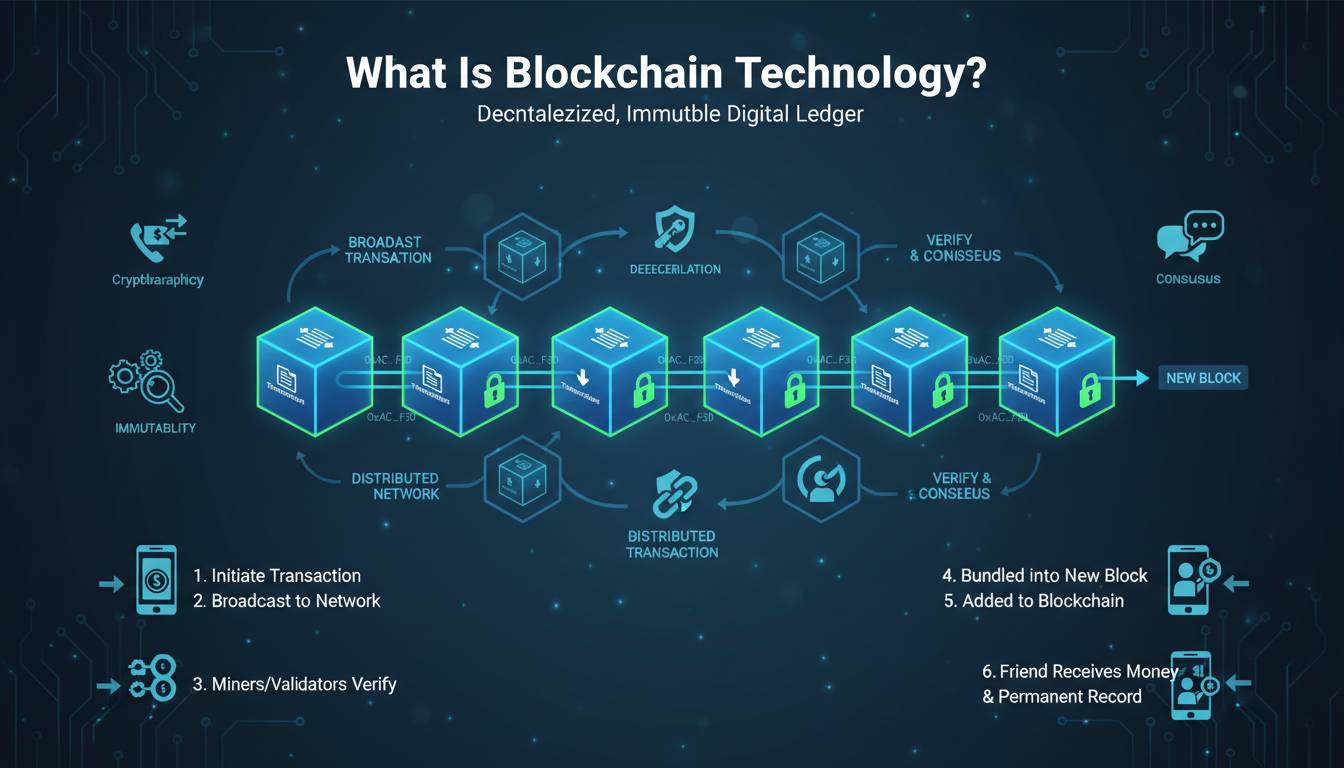
To truly grasp blockchain technology, you need to understand the step-by-step process that occurs whenever someone initiates a transaction. Let’s walk through what happens when you send cryptocurrency or record any data on a blockchain network.
Transaction Initiation: The process begins when a user creates a transaction—whether that’s sending digital currency, recording medical records, or verifying product authenticity. This transaction includes specific details: who is sending what, who is receiving it, and any additional data required by the specific blockchain application.
Broadcast to Network: Once created, the transaction is broadcast to the blockchain network, where it becomes visible to all participating nodes. At this point, the transaction sits in what’s called a “mempool” (memory pool), waiting to be confirmed and added to the blockchain.
Validation and Verification: Nodes in the network receive the transaction and begin verifying its legitimacy. They check whether the sender actually has the assets they’re trying to send, whether the transaction is properly formatted, and whether it follows all network rules. This validation process varies depending on the blockchain’s consensus mechanism—proof of work, proof of stake, or others—which we’ll explore in detail later.
Block Creation: Valid transactions are grouped together by validators (also called miners in proof-of-work systems) into a candidate block. The validator who successfully creates the block—the first to solve a complex mathematical puzzle in proof-of-work or the randomly selected validator in proof-of-stake—adds their block to the blockchain and broadcasts it to the network.
Network Confirmation: Other nodes verify the newly created block. If the majority of nodes agree the block is valid, it’s added to the blockchain permanently. This confirmation process typically requires multiple blocks to be added on top of your transaction for it to be considered fully settled, especially for large transactions where absolute certainty matters.
The entire process typically takes seconds to minutes, depending on the blockchain network and current transaction volume. Bitcoin, the original blockchain, processes approximately 7 transactions per second, while newer blockchains like Solana can handle tens of thousands of transactions per second.
Types of Blockchains: Public, Private, and Consortium
Not all blockchains are created equal. Understanding the different types helps you recognize which blockchain solutions might work best for various use cases.
Public Blockchains are open networks that anyone can join, participate in, and transact on. Bitcoin and Ethereum are the most prominent public blockchains. These networks offer maximum decentralization and transparency, but they often face trade-offs in transaction speed and energy consumption. Public blockchains are truly permissionless—nobody needs approval to send transactions or validate blocks.
Private Blockchains operate on restricted networks where participation requires invitation and approval from a central authority. These are often used by enterprises, financial institutions, and organizations that need blockchain’s benefits but require more control over who can access and modify the network. While private blockchains offer faster transactions and greater privacy, they sacrifice the decentralization that defines blockchain’s core value proposition.
Consortium Blockchains represent a middle ground—semi-decentralized networks governed by a group of organizations rather than a single entity. Financial institutions frequently use consortium blockchains for interbank settlements, where multiple banks share a common ledger while maintaining their own governance rules. These hybrid models aim to combine the trustless benefits of public blockchains with the efficiency and compliance capabilities enterprises require.
The choice between these blockchain types depends entirely on the use case. A decentralized finance application might require a public blockchain’s openness, while a supply chain tracking system for a corporation might benefit from a consortium model that maintains competitive privacy while enabling collaboration.
Consensus Mechanisms: How Blockchains Agree
The term “consensus mechanism” refers to how blockchain networks agree on which transactions are legitimate and in what order they occurred. This is one of blockchain’s most critical innovations—the method by which distributed nodes achieve agreement without trusting a central authority.
Proof of Work (PoW) was the first consensus mechanism, introduced by Bitcoin in 2009. In PoW, miners compete to solve complex mathematical puzzles, and the first to solve the puzzle gets to add the next block to the chain. This process requires substantial computational power and energy consumption. The security of PoW comes from the mathematical difficulty of the puzzles and the economic incentive structure: attacking the network would cost more than any potential gain. Bitcoin has proven PoW’s resilience over 15+ years of operation, though critics point to its environmental impact.
Proof of Stake (PoS) has emerged as the leading alternative consensus mechanism. In PoS, validators put up cryptocurrency as collateral (“staking”) to gain the right to create new blocks. If they behave dishonestly, their staked cryptocurrency gets confiscated (slashed). Ethereum completed its transition to PoS in 2022, reducing the network’s energy consumption by approximately 99.95%. PoS offers better energy efficiency while maintaining strong security guarantees, though it’s debated whether it provides the same economic security model as PoW.
Other Mechanisms exist beyond these two dominant models. Delegated Proof of Stake (DPoS) allows token holders to vote for representatives who validate transactions on their behalf, as used by EOS and Tron. Proof of Authority (PoA) relies on pre-approved validators, suitable for private networks. Each mechanism represents different trade-offs between decentralization, security, speed, and energy efficiency.
Real-World Applications and Use Cases
Beyond cryptocurrency, blockchain technology offers transformative potential across numerous industries. Understanding these applications helps illustrate why blockchain matters beyond speculative digital assets.
Financial Services represent the most mature blockchain application area. Cross-border payments that traditionally take 3-5 business days can settle in seconds using blockchain. Ripple’s network connects banks globally, enabling near-instant international transfers. Decentralized finance (DeFi) platforms now offer lending, borrowing, and trading without traditional financial intermediaries, with billions of dollars locked in these protocols.
Supply Chain Management benefits from blockchain’s ability to create transparent, immutable records of product journeys. Walmart uses IBM’s Food Trust network to track produce from farm to shelf, reducing food contamination investigation time from 7 days to 2.2 seconds. Diamond industry players use blockchain to verify gem authenticity and conflict-free sourcing.
Healthcare applications include secure sharing of medical records across providers while maintaining patient privacy. Patients can control who accesses their health data through blockchain-based permissions. Clinical trial data can be recorded immutably, preventing research fraud.
Real Estate transactions involve multiple intermediaries—lawyers, title companies, banks—each adding time and cost. Blockchain can streamline property transfers by creating a single, verified source of ownership data, potentially reducing closing times from weeks to days.
Digital Identity management represents another promising application. Instead of relying on centralized databases vulnerable to breaches, individuals can maintain self-sovereign identity records on blockchain, sharing verified credentials only as needed.
Advantages and Challenges of Blockchain Technology
Understanding both the benefits and limitations of blockchain provides a balanced perspective essential for anyone evaluating this technology.
Advantages include:
- Immutability: Once recorded, data cannot be changed without detection, creating trustworthy audit trails
- Transparency: Public blockchains allow anyone to verify transactions, reducing fraud and increasing accountability
- Decentralization: No single point of failure; the network continues operating even if some nodes go offline
- Security: Cryptographic protection makes unauthorized alterations virtually impossible
- Efficiency: Eliminates intermediaries, reducing costs and transaction times, especially for cross-border operations
- Trustless Verification: Parties don’t need to trust each other; they trust the protocol
Challenges include:
- Scalability: Public blockchains often process fewer transactions than traditional payment networks
- Energy Consumption: Proof-of-work blockchains require significant electricity (though this is improving with PoS adoption)
- Regulatory Uncertainty: Laws vary dramatically across countries, creating compliance challenges
- User Experience: Managing private keys and understanding blockchain concepts remains complex for average users
- Interoperability: Different blockchains often struggle to communicate, creating siloed ecosystems
- Irreversibility: While immutability is usually an advantage, it becomes problematic when legitimate errors occur
The blockchain community actively works on addressing these challenges. Layer 2 solutions like Bitcoin’s Lightning Network and Ethereum’s rollups dramatically improve transaction throughput. Regulatory frameworks are gradually emerging globally. User experience improves continuously as the technology matures.
Frequently Asked Questions
What is the main purpose of blockchain?
The primary purpose of blockchain is to enable trustless digital transactions—allowing parties who don’t know each other to exchange value or record information without requiring a trusted intermediary like a bank or government. It achieves this through decentralization, cryptographic security, and consensus mechanisms that make recorded data virtually impossible to alter retroactively.
Is blockchain the same as cryptocurrency?
No, blockchain and cryptocurrency are related but distinct concepts. Blockchain is the underlying technology—the distributed ledger system—while cryptocurrency is a digital asset that uses that technology. Bitcoin is cryptocurrency; the Bitcoin blockchain is the network that records all Bitcoin transactions. Many blockchains don’t have associated cryptocurrencies, and many cryptocurrencies don’t use blockchain (though most do).
Can blockchain be hacked?
While no system is perfectly secure, successfully hacking a well-established public blockchain like Bitcoin or Ethereum is extraordinarily difficult. An attacker would need to control more than 50% of the network’s computing power (for proof of work) or staked cryptocurrency (for proof of stake) to manipulate the blockchain, requiring enormous resources that would exceed any potential gain. Private blockchains with fewer nodes are more vulnerable to attacks.
How long does a blockchain transaction take?
Transaction times vary significantly by blockchain. Bitcoin typically takes 10-60 minutes for confirmation, while Ethereum transactions usually confirm within seconds to minutes. Newer blockchains like Solana or Avalanche can process transactions in under a second. The exact time depends on network congestion, the fee paid, and the specific blockchain’s design.
Do I need technical knowledge to use blockchain?
Basic blockchain usage has become increasingly user-friendly. Most people can set up a cryptocurrency wallet, send transactions, or interact with blockchain applications without deep technical knowledge. However, managing your own assets (self-custody) requires understanding basic security practices like protecting private keys. For enterprise applications, technical expertise is typically needed for implementation and integration.
What is the future of blockchain technology?
The future likely involves greater mainstream adoption, improved scalability, and increased interoperability between different blockchains. Enterprise adoption is accelerating, with major companies integrating blockchain for supply chain, finance, and identity applications. Regulatory frameworks will mature, providing clearer guidelines. The convergence of blockchain with other emerging technologies like artificial intelligence and the Internet of Things suggests many innovative applications remain to be discovered.
Conclusion
Blockchain technology represents a fundamental shift in how we think about trust, ownership, and record-keeping in the digital age. From its origins as the technology behind Bitcoin to its current applications spanning finance, healthcare, supply chains, and beyond, blockchain has proven itself as more than a passing trend.
The key takeaways from this guide are: blockchain creates trustworthy, transparent, and immutable records without requiring centralized intermediaries; it works through distributed networks that validate and record transactions cryptographically; different types of blockchains serve different needs; and while challenges remain, the technology continues maturing rapidly.
Whether you’re simply curious about how cryptocurrency works or you’re evaluating blockchain solutions for business applications, understanding these fundamentals provides a solid foundation for navigating this transformative technology. As blockchain continues evolving, its principles of decentralization, transparency, and cryptographic security will likely influence digital systems for decades to come.