
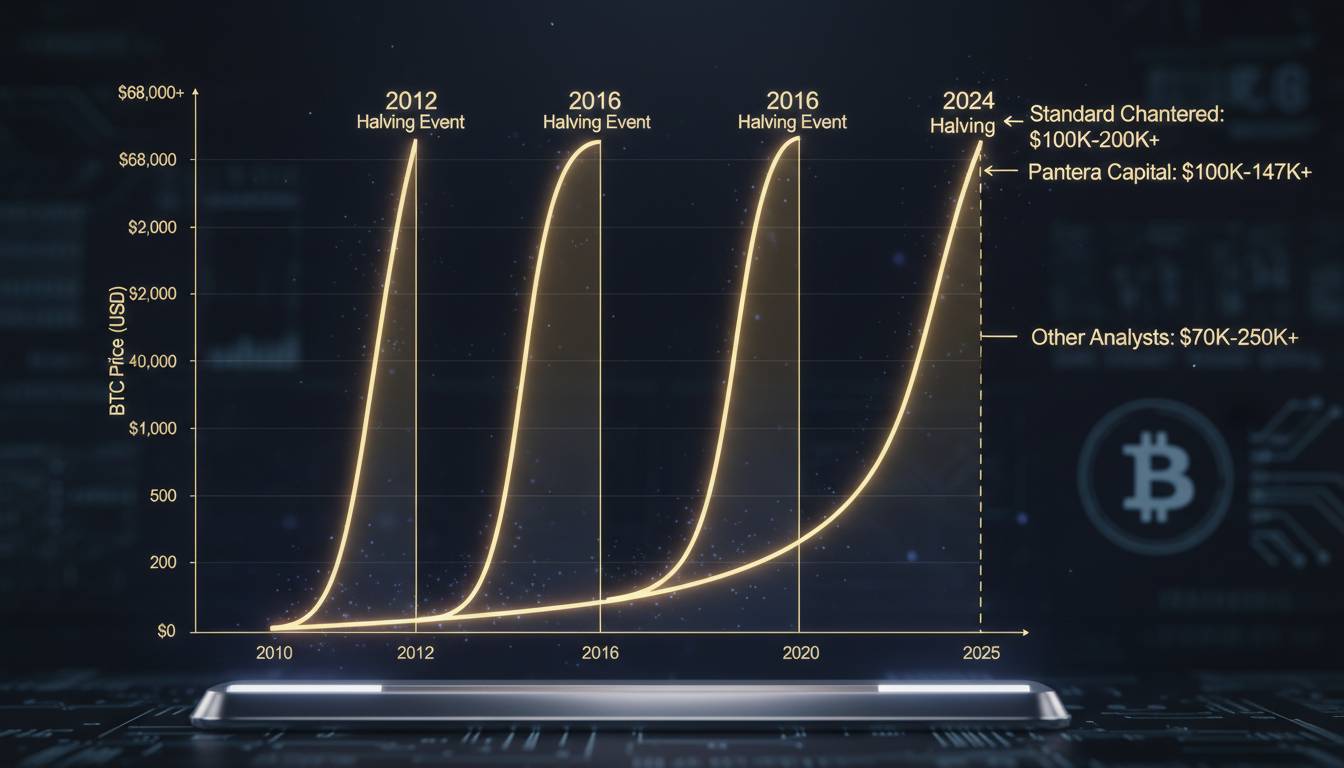
The Bitcoin halving scheduled for April 2024 is drawing attention from investors trying to figure out what happens next. This guide looks at what the halving means, how it’s played out historically, and where prices might go.
How Bitcoin Halving Works
Bitcoin’s supply is capped at 21 million coins, and the protocol automatically reduces miner rewards roughly every four years. When Bitcoin started, miners got 50 BTC per block. That dropped to 25 BTC in 2012, then 12.5 BTC in 2016, and 6.25 BTC in 2020. In 2024, it drops to 3.125 BTC.
The idea is simple: slower new supply should support higher prices if demand holds steady. Whether that actually plays out in practice is another matter—plenty of other factors move Bitcoin’s price.
What Happened After Previous Halvings
Looking at past cycles gives some context, though every situation is different.
The 2012 halving happened when Bitcoin was around $12. By the next year, it hit nearly $1,100—a massive run-up, but Bitcoin was tiny back then. The 2016 halving came at about $650, and the price climbed to around $20,000 by late 2017. The 2020 halving occurred near $9,000 during COVID chaos, and Bitcoin eventually topped $64,000 in 2021.
One thing to notice: the percentage gains got smaller each time. That’s not surprising given how much bigger Bitcoin’s market cap became. Whether that pattern continues is anyone’s guess.
What’s Different This Time
The 2024 halving arrives when Bitcoin has far more institutional involvement than before. Several major investment firms now offer cryptocurrency products to clients, and the approval of Bitcoin ETFs in the US marked a major turning point. This changes the game from earlier cycles when retail investors dominated.
The broader economy is also a factor. Interest rates, inflation, and global financial conditions all affect how people feel about risk assets like Bitcoin. None of this is predictable with precision.
Price Predictions: The Range of Views
Analysts have all sorts of predictions, and they span a wide range.
Some bullish voices point to $100,000–$150,000, arguing that shrinking supply combined with growing demand from institutions could trigger another major rally. Others see a more modest outcome—maybe $60,000–$80,000—given Bitcoin’s maturation and the reduced percentage gains from previous cycles. Bearish scenarios warn of $30,000–$40,000 if regulation gets hostile or the economy tanks.
The honest answer is that nobody knows. These predictions all make assumptions about factors that are fundamentally unpredictable.
What Actually Moves Bitcoin Price
The halving is one variable among many:
- Institutional adoption: Big financial players keep building out crypto capabilities. More legitimacy generally means more demand.
- Regulation: Governments are still figuring out how to handle crypto. Clearer rules could help; heavy-handed enforcement could hurt.
- Network activity: Wallet creation, transaction volumes, and hash rate all give clues about real usage. Higher activity often correlates with price gains.
- Macroeconomics: Bitcoin competes with stocks, bonds, and other assets. When money is cheap and plentiful, it tends to flow into risk assets.
Should You Buy?
If you’re thinking about Bitcoin exposure, a few things to keep in mind.
First, only invest money you can afford to lose. Bitcoin is volatile—prices can swing 20% or more in either direction quickly. Second, think about your time horizon. Short-term trading around events like the halving is notoriously difficult to time. Dollar-cost averaging—buying a set amount regularly—is one way to smooth out some of the volatility.
Nobody can tell you what Bitcoin will do next. The best approach is to understand what you’re actually buying and why.
Common Questions
When does the halving happen?
Mid-April 2024 is the estimate. The exact timing shifts slightly depending on block generation speed.
What was Bitcoin’s price after past halvings?
2012: ~$12 → ~$1,100 within a year. 2016: ~$650 → ~$20,000 by 2017. 2020: ~$9,000 → ~$64,000 by 2021.
Should I buy before the halving?
That’s your call. Past performance doesn’t guarantee future results, and you’re not getting a discount by waiting or buying now.
What could go wrong?
Regulatory crackdown, economic recession, or simply market fatigue could all push prices down. Bitcoin also faces competition from thousands of other crypto projects now.
How does halving affect miners?
Revenue per block gets cut in half. Some miners may shut down if prices don’t rise enough to compensate. The survivors face less sell pressure from new supply, which could help prices long-term.
Bottom Line
The 2024 halving is a notable event in Bitcoin’s roadmap, but it’s not magic. Whether it produces another big price run, a modest gain, or a disappointment depends on factors far beyond the halving itself.
The safest thing to say is that Bitcoin has reached new highs after each halving so far—but that pattern may not hold forever, and it certainly doesn’t tell you anything precise about timing or magnitude. Do your own research, manage your risk, and don’t bet more than you can handle losing.