
The cryptocurrency market continues to captivate investors, traders, and financial analysts worldwide, with daily trading volumes often surpassing $100 billion. As digital assets like Bitcoin, Ethereum, and thousands of altcoins experience unprecedented volatility, the demand for reliable cryptocurrency price prediction methods has never been higher. Understanding how analysts forecast price movements in this rapidly evolving market offers valuable insights for anyone looking to navigate the complex world of digital assets.
What Is Cryptocurrency Price Prediction?
Cryptocurrency price prediction refers to the practice of forecasting future price movements of digital currencies using various analytical methods, statistical models, and market indicators. Unlike traditional financial markets, the cryptocurrency market operates around the clock, with prices influenced by a unique combination of technological developments, regulatory announcements, market sentiment, and macroeconomic factors.
Professional analysts and automated systems employ multiple approaches to predict cryptocurrency prices. These methods range from technical analysis, which examines historical price charts and trading volumes, to fundamental analysis, which evaluates underlying project fundamentals such as team expertise, tokenomics, and real-world adoption. The intersection of these methodologies creates a comprehensive framework for understanding potential market movements.
The importance of cryptocurrency price prediction extends beyond mere speculation. Institutional investors, hedge funds, and retail traders alike rely on these forecasts to make informed investment decisions, manage risk exposure, and optimize portfolio performance. As the market matures, prediction methodologies continue to evolve, incorporating artificial intelligence, machine learning, and advanced statistical techniques to improve accuracy.
Key Factors Influencing Crypto Market Movements
Several fundamental factors drive cryptocurrency prices, and understanding these elements is essential for accurate prediction. Supply and demand dynamics play a central role in determining asset valuations. For Bitcoin, the fixed supply cap of 21 million coins creates inherent scarcity that influences long-term price trajectories. Similarly, token unlock schedules and emission rates significantly impact altcoin valuations.
Regulatory developments represent another critical factor shaping cryptocurrency markets. Government announcements regarding taxation, trading restrictions, or institutional adoption can trigger substantial price movements within hours. Recent years have seen major economies including the United States, European Union member states, and Asian markets implement varying regulatory frameworks that directly affect market sentiment and trading conditions.
Market liquidity and trading volume serve as vital indicators of price stability and potential movement magnitude. Assets with higher trading volumes typically exhibit less volatility and more predictable price action. Conversely, lower-liquidity cryptocurrencies can experience dramatic price swings based on relatively small trade sizes, making prediction more challenging but potentially more profitable for skilled traders.
Technical Analysis Tools and Methods
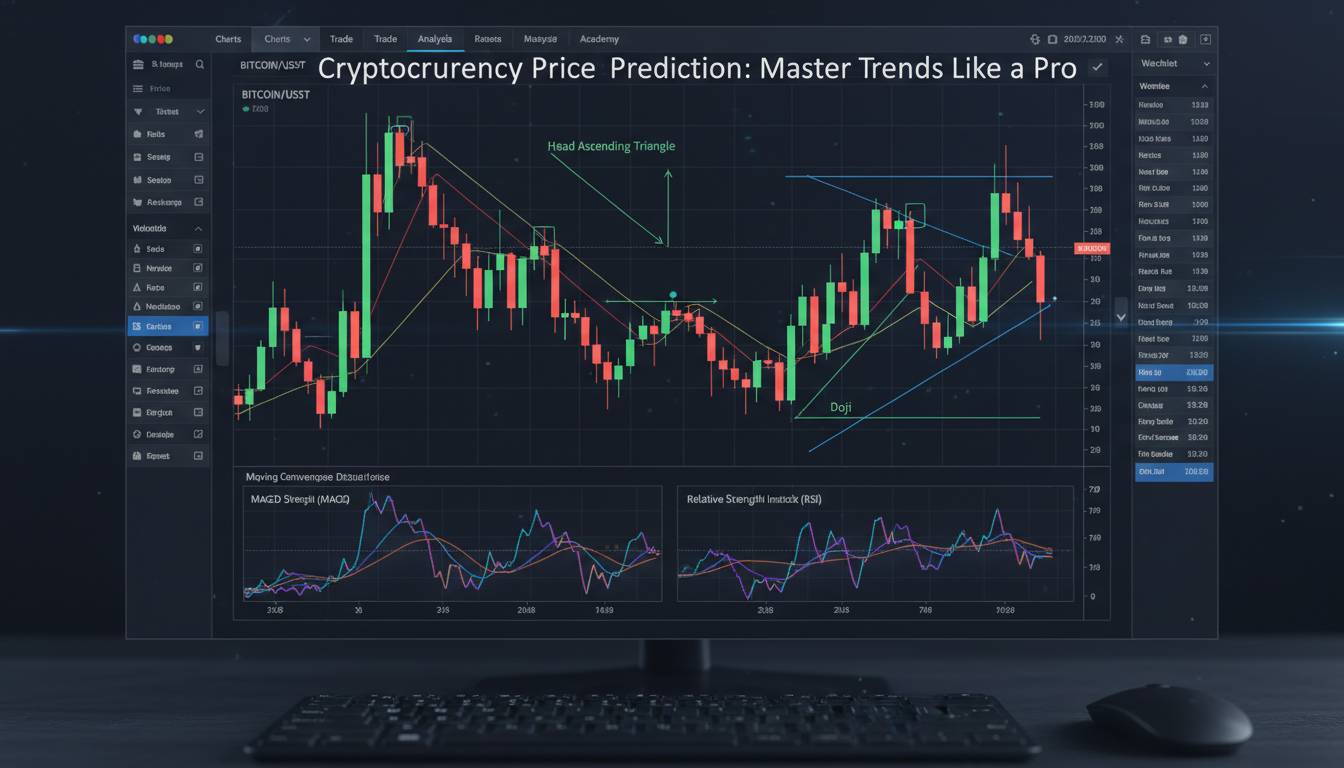
Technical analysis forms the backbone of many cryptocurrency price prediction strategies. Traders examine price charts across various timeframes, from intraday charts spanning minutes to monthly views covering years of historical data. Common technical indicators help identify trends, momentum, and potential reversal points.
Moving averages represent some of the most widely used technical tools. The Simple Moving Average calculates average closing prices over a specified period, while the Exponential Moving Average places greater weight on recent prices, reacting more quickly to market changes. When an asset’s price crosses above its moving average, traders often interpret this as a bullish signal, while crosses below may indicate bearish momentum.
Relative Strength Index (RSI) measures the magnitude and speed of recent price changes to determine whether an asset is overbought or oversold. Values above 70 typically suggest overbought conditions potentially leading to price corrections, while values below 30 may indicate oversold conditions and potential recovery opportunities. Many cryptocurrency traders combine RSI analysis with other indicators to confirm trading signals.
The Moving Average Convergence Divergence (MACD) indicator helps identify changes in trend strength, direction, momentum, and duration. Consisting of the MACD line, signal line, and histogram, this tool enables traders to spot potential bullish or bearish crossovers that may indicate upcoming price movements. Bollinger Bands, Fibonacci retracement levels, and volume profile analysis further enhance technical forecasting capabilities.
The Role of Market Sentiment and News
Beyond technical and fundamental analysis, market sentiment significantly influences cryptocurrency price movements. Fear and greed indices aggregate various market signals to provide a numerical representation of overall market mood. Extreme fear often precedes buying opportunities, while excessive greed may signal market tops and potential corrections.
News events carry substantial weight in cryptocurrency markets due to the relatively small market capitalization compared to traditional asset classes. Major announcements from influential figures, technology upgrades, partnership reveals, or security incidents can trigger immediate and dramatic price responses. Traders monitoring news feeds and social media platforms gain valuable insights into potential market-moving events before they reflect in price action.
Social media sentiment analysis has emerged as a powerful tool for cryptocurrency price prediction. Platforms like Twitter/X, Reddit, and specialized crypto forums host vibrant communities whose collective opinions can influence market direction. Sophisticated algorithms now scan these platforms to gauge sentiment shifts that may precede price movements, providing traders with additional data points for their forecasting models.
On-chain metrics provide another dimension of market intelligence. Blockchain data reveals wallet activity, transaction volumes, exchange flows, and network growth patterns. When large quantities of cryptocurrency move to exchanges, analysts often anticipate increased selling pressure. Conversely, growing network adoption and decreasing exchange reserves may suggest accumulation and potential price appreciation.
Expert Perspectives on Prediction Accuracy
Industry experts acknowledge the inherent challenges of cryptocurrency price prediction while emphasizing the value of systematic analysis. Financial analysts consistently note that while perfect prediction remains impossible, combining multiple methodologies improves forecasting probability. No single indicator or approach provides reliable signals in isolation.
Research from academic institutions and financial firms has examined cryptocurrency market efficiency. Studies indicate that while markets exhibit some degree of predictability, information integration occurs rapidly, limiting opportunities for sustained arbitrage. Professional traders emphasize risk management and position sizing rather than relying solely on prediction accuracy.
“Technical analysis provides a framework for understanding market psychology and potential support or resistance levels,” noted one senior market analyst at a leading cryptocurrency research firm. “However, successful trading requires combining chart patterns with fundamental understanding and disciplined risk management protocols.”
Machine learning and artificial intelligence have transformed prediction methodologies in recent years. Neural networks and deep learning models analyze vast datasets encompassing price history, social media activity, news headlines, and on-chain metrics to identify patterns imperceptible to human analysis. While these systems offer enhanced processing capabilities, they require careful validation and remain subject to the inherent unpredictability of markets.
Risks and Limitations of Price Forecasting
Despite advancing methodologies, cryptocurrency price prediction carries significant limitations that traders must acknowledge. The market’s relatively short history compared to traditional financial markets limits historical data availability for model training. Additionally, the sector’s susceptibility to manipulation, pump-and-dump schemes, and sudden regulatory changes creates unpredictable variables that challenge even sophisticated forecasting systems.
Overfitting represents a common pitfall in prediction model development. Models optimized too closely on historical data may fail to adapt to evolving market conditions. Traders must regularly validate and adjust their approaches to maintain effectiveness in changing environments.
Emotional discipline proves essential for anyone relying on price predictions. Confirmation bias, fear of missing out, and panic selling often lead traders to disregard analytical signals in favor of emotional reactions. Successful market participants develop systematic approaches that minimize emotional decision-making while maintaining flexibility to adjust when evidence warrants.
The volatile nature of cryptocurrency markets means that even professionally constructed predictions may prove inaccurate. Portfolio diversification, stop-loss orders, and position sizing strategies help manage downside risk regardless of prediction accuracy. No forecasting method guarantees success, and investors should only allocate capital they can afford to lose.
Conclusion
Cryptocurrency price prediction combines technical analysis, fundamental research, sentiment assessment, and increasingly sophisticated technological tools to forecast market movements. While no methodology guarantees accuracy, systematic approaches help traders and investors make more informed decisions in this dynamic market. Understanding the various factors influencing cryptocurrency prices, from regulatory developments to on-chain metrics, provides a comprehensive foundation for analysis.
The key to successful market participation lies not in achieving perfect prediction but in managing risk, maintaining disciplined strategies, and adapting to evolving market conditions. As the cryptocurrency market continues to mature, prediction methodologies will undoubtedly advance, offering participants increasingly refined tools for navigating digital asset investments.
Frequently Asked Questions
How accurate are cryptocurrency price predictions?
Cryptocurrency price predictions vary significantly in accuracy depending on the methodology used, market conditions, and timeframes analyzed. Professional analysts combining multiple approaches typically achieve modest accuracy advantages over random chance, but no prediction method guarantees correct forecasts. The highly volatile nature of crypto markets means predictions should be treated as educated estimates rather than certainties.
What are the best tools for predicting cryptocurrency prices?
Popular tools include technical analysis platforms like TradingView, fundamental analysis resources such as coin metrics websites, sentiment analysis tools, and AI-powered prediction services. Many traders use combinations of moving averages, RSI, MACD, and on-chain metrics to inform their forecasts. The best approach often involves personal research and finding methodologies that align with individual trading styles.
Can artificial intelligence accurately predict crypto prices?
AI and machine learning models can identify patterns in large datasets and provide data-driven insights, but they face limitations including changing market conditions, unforeseen events, and the inherent unpredictability of markets. AI should be viewed as one tool among many rather than a definitive answer to price prediction.
How do I start learning cryptocurrency price prediction?
Begin by understanding basic technical analysis concepts including chart patterns, indicators, and support/resistance levels. Study fundamental analysis including tokenomics, project utility, and market positioning. Practice on paper trading platforms before risking real capital, and always maintain disciplined risk management strategies.
What factors should I consider before making a crypto investment?
Evaluate the project’s fundamental value including technology, team, use case, and community. Consider regulatory environments in relevant jurisdictions, market sentiment, and overall portfolio diversification. Never invest more than you can afford to lose, and maintain long-term perspective rather than focusing solely on short-term price movements.
Is cryptocurrency price prediction legal?
Yes, cryptocurrency price prediction and analysis are legal activities. Analysts, researchers, and traders regularly publish predictions and forecasts. However, misleading predictions intended to manipulate markets for personal gain may constitute securities fraud or market manipulation, which remain illegal.