
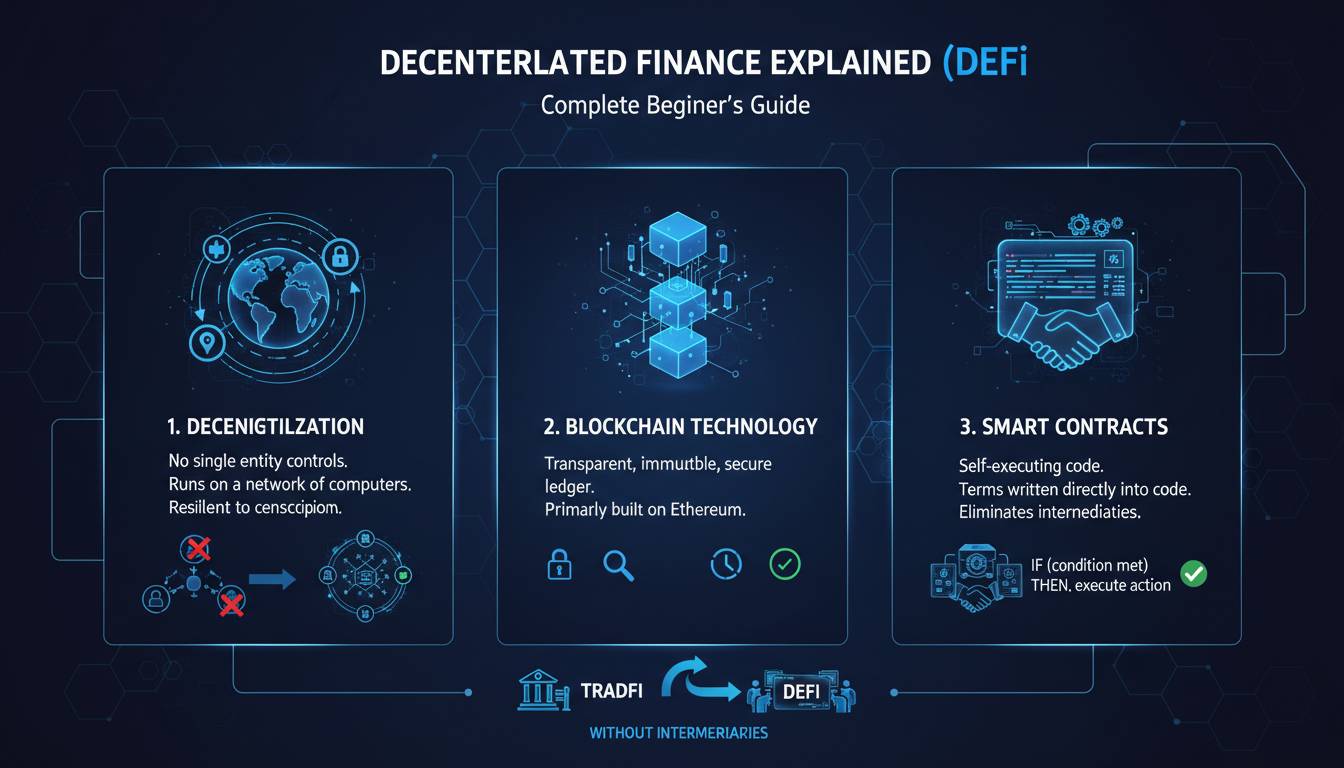
Decentralized finance, commonly known as DeFi, is changing how people access financial services. Instead of relying on banks and brokerages as middlemen, DeFi uses blockchain technology to let people transact directly with each other. This guide covers what decentralized finance is, how it works, its key components, and where the sector is heading.
What is Decentralized Finance?
Decentralized finance (DeFi) is an emerging financial technology that removes intermediaries from traditional financial transactions by using secure distributed ledgers similar to those used by cryptocurrencies. In simple terms, DeFi creates an open-source, transparent financial ecosystem where anyone with an internet connection can access financial services without needing to trust a central authority.
The core idea behind decentralized finance is eliminating gatekeepers that control access to financial products. Traditional financial institutions act as trusted third parties that facilitate transactions, verify identities, and maintain records. DeFi replaces these institutional functions with code-based smart contracts that automatically execute when predetermined conditions are met. This approach has the potential to make financial services more accessible, transparent, and efficient for millions of people worldwide who remain unbanked or underbanked in the traditional financial system.
According to data from DeFi Llama, the total value locked in DeFi protocols reached approximately $55 billion in early 2024, up from virtually zero just a few years earlier. This growth reflects increasing interest from both institutional and retail participants in decentralized financial products.
How Does DeFi Work?
Decentralized finance operates on blockchain networks, with Ethereum serving as the primary foundation for most DeFi applications. The technology relies on several interconnected components that work together to create a financial infrastructure.
Smart contracts form the backbone of DeFi. These are self-executing programs stored on the blockchain that automatically enforce agreements between parties when specific conditions are fulfilled. Unlike traditional contracts that require lawyers and courts to enforce them, smart contracts execute automatically, removing the need for trusted intermediaries. Once a smart contract is deployed, it operates continuously without interruption, ensuring that the coded rules are followed precisely.
Decentralized applications, known as dApps, interface with these smart contracts to provide user-friendly platforms for financial activities. Users interact with dApps through cryptocurrency wallets, which serve as their identity and access point to the DeFi ecosystem. Popular wallet providers include MetaMask, Rainbow, and Coinbase Wallet, each offering varying levels of security and functionality.
The transparency inherent in blockchain technology means that all transactions and smart contract code are publicly viewable. This openness allows anyone to audit the financial systems, verify that rules are being followed, and identify potential vulnerabilities before they can be exploited.
Key Components of DeFi
Understanding decentralized finance requires familiarity with its essential building blocks. Several key components power the DeFi ecosystem and enable its diverse range of financial applications.
Stablecoins represent one of the most important DeFi innovations. These cryptocurrencies maintain a fixed value, typically pegged to a fiat currency like the US dollar, by holding reserves of collateral or using algorithmic mechanisms. Popular stablecoins include USDT, USDC, and DAI. Stablecoins solve the volatility problem that makes traditional cryptocurrencies impractical for everyday transactions, enabling users to transact in a currency that maintains predictable value while still benefiting from blockchain technology.
Decentralized exchanges, commonly called DEXs, allow users to trade cryptocurrencies directly from their wallets without depositing funds on a centralized platform. Uniswap, SushiSwap, and Curve Finance are leading DEXs that use automated market maker mechanisms to determine asset prices algorithmically rather than through order books. This approach reduces counterparty risk and eliminates the need for exchanges to hold user funds.
Lending and borrowing protocols have become major DeFi applications. Platforms like Aave, Compound, and MakerDAO enable users to lend their cryptocurrency assets to others and earn interest, or to borrow assets by providing collateral. Interest rates in these protocols are determined algorithmically based on supply and demand, often offering more competitive rates than traditional savings accounts or loans.
Popular DeFi Protocols and Examples
The DeFi ecosystem has produced numerous protocols that serve millions of users globally. Understanding these examples provides insight into how decentralized finance functions in practice.
Uniswap is the largest decentralized exchange by trading volume. Launched in 2018, it introduced the automated market maker model that has since been adopted across the industry. Users can swap any ERC-20 token pair directly from their wallets, with liquidity providers earning a share of trading fees.
Aave is a leading lending protocol, allowing users to deposit assets and earn interest or borrow against their collateral. The protocol pioneered flash loans, a unique DeFi feature that enables users to borrow funds without collateral as long as the loan is repaid within a single blockchain transaction.
MakerDAO operates the Dai stablecoin system, which maintains its peg through a system of collateralized debt positions. Users lock cryptocurrency into smart contracts as collateral and generate Dai stablecoins against that value, creating a decentralized mechanism for creating stable-value tokens without central authority.
Risks and Benefits of DeFi
Decentralized finance presents both significant opportunities and notable risks that prospective users must carefully consider. A balanced understanding of these factors is essential for anyone exploring the DeFi space.
The benefits of DeFi extend beyond technological innovation. Financial inclusion remains one of the most compelling arguments for decentralized finance, as anyone with internet access can participate without needing traditional banking relationships. The open nature of DeFi protocols means that anyone can build new applications on existing infrastructure, fostering innovation and competition that often leads to better rates for users.
However, the DeFi space carries substantial risks that cannot be overlooked. Smart contract vulnerabilities have resulted in millions of dollars in losses across numerous high-profile hacks. The immutable nature of blockchain means that once funds are stolen, recovery is nearly impossible. Regulatory uncertainty also poses risks, as governments worldwide continue to develop frameworks for cryptocurrency and DeFi regulation.
Decentralized Finance vs Traditional Finance (CeFi)
The distinction between DeFi and centralized finance, often called CeFi, represents a fundamental philosophical divide in how financial services can be delivered.
Traditional financial institutions operate under strict regulatory frameworks that protect consumers but create barriers to entry. Opening a bank account requires extensive verification processes, and accessing certain financial products demand credit histories and documentation that many people cannot provide. These requirements, while serving legitimate purposes, exclude roughly 1.4 billion adults globally who lack access to basic banking services.
DeFi attempts to solve these problems by removing gatekeepers while simultaneously removing the protections they provide. Users maintain complete control over their funds and data but assume full responsibility for security and decision-making. There are no customer service representatives to call when funds are lost, no insurance protecting deposits, and no ability to reverse mistaken transactions.
How to Get Started with DeFi
For those interested in exploring decentralized finance, several steps can help ensure a safe and informed entry into the ecosystem.
First, users should acquire a cryptocurrency wallet and familiarize themselves with its security features. Hardware wallets provide the highest security for significant holdings, while software wallets offer convenience for smaller amounts and regular trading activity.
Next, users should acquire cryptocurrency through reputable exchanges, purchasing tokens like Ethereum that power most DeFi applications. Starting with small amounts allows users to learn how transactions work without risking substantial capital.
Before interacting with any DeFi protocol, thorough research is essential. Users should understand how specific protocols function, review audit reports when available, and start with small test transactions to verify everything works as expected.
Frequently Asked Questions
What is the main purpose of decentralized finance?
Decentralized finance aims to recreate traditional financial services like lending, borrowing, and trading without relying on intermediaries such as banks. It seeks to increase financial accessibility, reduce costs, and remove centralized control from financial systems.
Is DeFi safe to use?
DeFi carries significant risks including smart contract vulnerabilities, hacks, and total loss of funds. Users should only invest what they can afford to lose, use hardware wallets for large holdings, and thoroughly research protocols before committing funds.
How does DeFi make money?
DeFi generates returns through several mechanisms including trading fees collected on decentralized exchanges, interest from lending protocols, and liquidity provision incentives. Users can earn passive income by supplying liquidity or staking tokens in various protocols.
What is the difference between DeFi and cryptocurrency?
Cryptocurrency refers to digital currencies like Bitcoin and Ethereum, while DeFi describes the broader ecosystem of financial applications built on blockchain technology. Cryptocurrencies are assets, whereas DeFi represents the infrastructure and services that utilize those assets.
Do I need a bank account to use DeFi?
No, one of DeFi’s primary advantages is that users only need an internet connection and a cryptocurrency wallet. This makes financial services accessible to the unbanked population worldwide without requiring traditional banking relationships.
What blockchain is DeFi built on?
Ethereum hosts the majority of DeFi applications, though other blockchains like Solana, Avalanche, and Binance Smart Chain have developed their own DeFi ecosystems. Cross-chain bridges now allow users to move assets between different blockchain networks.
Conclusion
Decentralized finance is changing how financial systems can function. By leveraging blockchain technology and smart contracts, DeFi removes traditional gatekeepers and creates accessible, transparent financial infrastructure available to anyone with an internet connection.
The sector continues to evolve rapidly, with institutional adoption increasing and new use cases emerging regularly. While significant risks remain, including security vulnerabilities and regulatory uncertainty, the fundamental promise of decentralized finance—financial services without intermediaries—continues to attract participants worldwide.
For those considering entry into the DeFi space, education remains paramount. Understanding how protocols work, recognizing the risks involved, and starting with small investments can help users safely explore this new frontier of financial technology. As the ecosystem matures, decentralized finance may reshape the relationship between individuals and money in ways that extend far beyond what we can currently imagine.