
Ethereum (ETH), the second-largest cryptocurrency by market capitalization, continues to be a focal point for investors, traders, and blockchain enthusiasts. As of early 2026, Ethereum’s price action has demonstrated remarkable resilience amid broader market volatility, with institutional adoption and network upgrades driving increased investor interest. Understanding the key technical levels, fundamental drivers, and market sentiment factors can help traders and investors make more informed decisions about Ethereum holdings.
This comprehensive analysis examines the current Ethereum price landscape, identifies critical support and resistance levels, explores the fundamental factors influencing price action, and provides a balanced outlook for potential future scenarios. Whether you are a seasoned trader or a newcomer to cryptocurrency markets, understanding these elements is essential for navigating the dynamic Ethereum ecosystem.
Understanding Ethereum’s Market Position
Ethereum remains the dominant smart contract platform in the cryptocurrency space, powering thousands of decentralized applications (dApps), decentralized finance (DeFi) protocols, and non-fungible token (NFT) marketplaces. The network’s transition to proof-of-stake (PoS) with “The Merge” upgrade in September 2022 marked a significant milestone, reducing energy consumption by approximately 99.95% and fundamentally changing the network’s economic model.
The proof-of-stake mechanism now allows ETH holders to stake their tokens and earn yield, effectively turning the asset into a productive asset class. This development has attracted significant institutional interest, with major financial institutions offering Ethereum staking products to their clients. The reduction in new ETH issuance following The Merge has also created supply-side dynamics that many analysts consider bullish for long-term price appreciation.
Ethereum’s market capitalization typically represents 15-20% of the total cryptocurrency market, making it a bellwether for the broader digital asset space. When Ethereum performs well, altcoins often follow; conversely, weakness in ETH can drag down the entire market. This correlation means that understanding Ethereum’s price dynamics provides valuable insights for the broader crypto market.
Key Technical Levels to Watch
Technical analysis plays a crucial role in identifying potential price movements and strategic entry/exit points for Ethereum. Several key levels have emerged as critical reference points for traders.
Support Levels
Major Support Zone: $2,800-$3,000
The $2,800-$3,000 range has established itself as a significant support zone throughout 2025 and into early 2026. This area represents multiple technical confluences: the 200-day moving average, previous resistance turned support, and psychological round numbers. Historical price action shows that this zone has been tested multiple times and has held firm during market corrections.
Secondary Support: $2,400-$2,600
Should the major support zone fail, the $2,400-$2,600 range represents the next significant technical floor. This area aligns with the 0.382 Fibonacci retracement level from the 2023 lows to the 2025 highs, providing a mathematically significant support level.
Critical Support: $2,000-$2,200
The $2,000-$2,200 range represents a critical psychological and technical level. This zone coincides with the previous cycle’s all-time high and represents a major psychological barrier. A breach of this level would signal a more significant market structure change.
Resistance Levels
First Resistance: $3,400-$3,600
The $3,400-$3,600 range represents the immediate resistance zone. This area aligns with previous swing highs and the 0.236 Fibonacci retracement level from the 2025 correction. Breaking above this level would signal short-term bullish momentum.
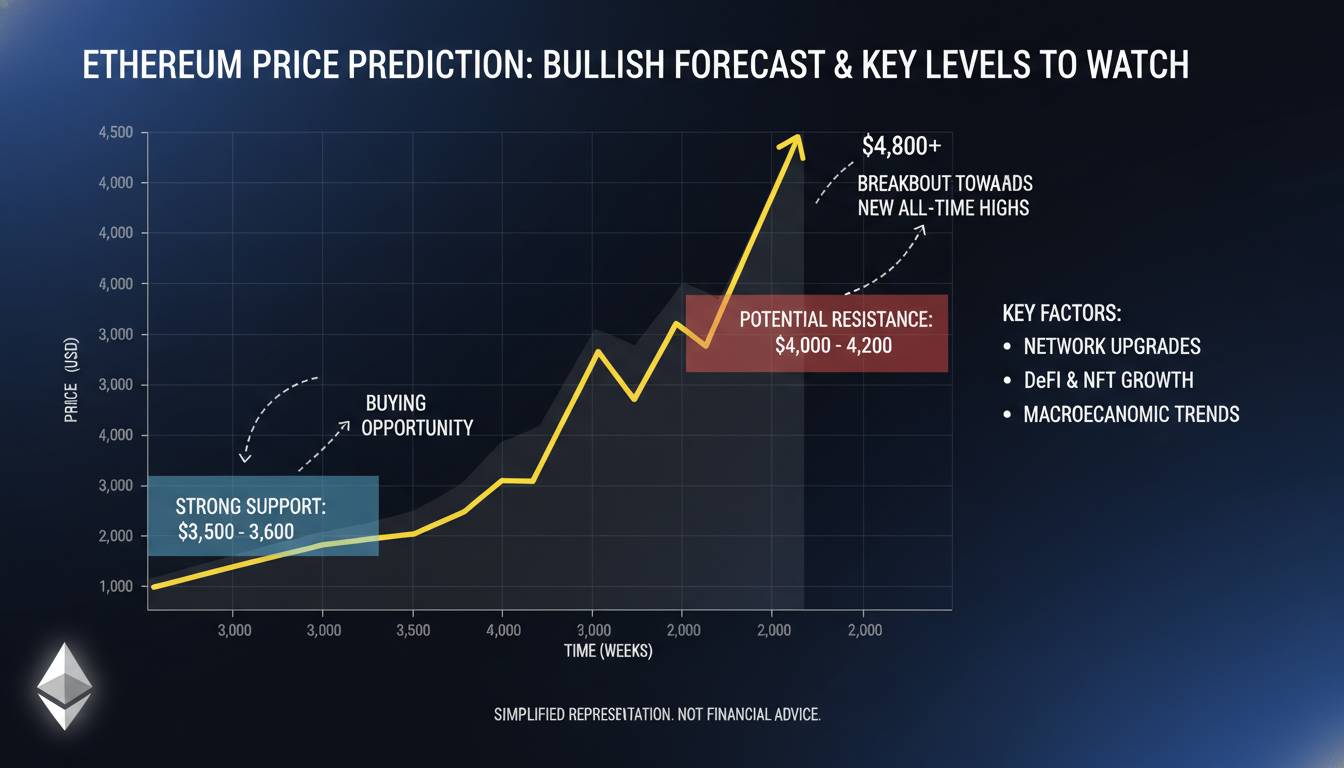
Major Resistance: $4,000-$4,200
The $4,000-$4,200 range represents a significant psychological and technical barrier. This level has historically acted as strong resistance, with multiple failed breakout attempts in previous market cycles. A sustained break above $4,200 would open the door to new all-time highs.
Breakout Target: $4,800-$5,000
The $4,800-$5,000 range represents the next major technical target on a breakout above $4,200. This area aligns with the 1.618 Fibonacci extension from the 2023 lows and represents a classic technical projection.
Fundamental Drivers of Ethereum Price
Several fundamental factors continue to influence Ethereum’s price trajectory, extending beyond simple technical analysis.
Institutional Adoption
The approval of Ethereum-based exchange-traded funds (ETFs) in the United States marked a watershed moment for institutional adoption. These products have attracted billions of dollars in assets under management, providing traditional investors with regulated exposure to Ethereum. The influx of institutional capital has increased market depth and reduced volatility over time.
Major asset managers including BlackRock, Fidelity, and Grayscale have launched Ethereum-focused products, legitimizing ETH as an investment asset class. This institutional participation brings increased research coverage, regulatory clarity, and market maturity.
Network Activity and User Adoption
Ethereum’s network activity serves as a fundamental driver of value. Total value locked (TVL) in DeFi protocols, NFT trading volumes, and transaction counts all contribute to the network’s utility and, by extension, its token value.
The implementation of layer-2 scaling solutions, particularly Optimism and Arbitrum, has significantly reduced transaction costs and increased throughput. These improvements have made Ethereum more accessible for everyday users, driving increased adoption. The Dencun upgrade, implemented in early 2024, introduced proto-danksharding, further reducing data costs for rollups.
Supply Dynamics
The transition to proof-of-stake fundamentally changed Ethereum’s supply dynamics. Annual inflation has been reduced to near-zero or even deflationary levels depending on network activity and staking participation. When transaction fees are burned through the EIP-1559 mechanism, the net issuance can become negative, effectively reducing the circulating supply over time.
This supply-side shock, combined with steady demand from institutional and retail investors, creates conditions that many analysts consider structurally bullish for long-term price appreciation.
Market Sentiment and Psychology
Market sentiment plays a significant role in short-term price movements, often driving prices away from fundamental values before mean reversion occurs.
Fear and Greed Index
The Crypto Fear and Greed Index provides a useful gauge of market sentiment. Historically, extreme fear levels have marked local bottoms, while extreme greed has preceded corrections. As of early 2026, the index has shown moderate optimism, suggesting neither extreme panic nor euphoria.
Social Media and Sentiment Analysis
Social media platforms continue to influence cryptocurrency price movements. Twitter/X remains the primary venue for crypto discussion, with influential accounts and developers often moving markets with their statements. However, the relationship between social media sentiment and price is not always straightforward, and savvy traders use multiple data sources.
Market Cycle Analysis
Understanding market cycles helps provide context for price predictions. Cryptocmarkets have historically moved in four-year cycles tied to Bitcoin halving events. Following this framework, the period following the 2024 Bitcoin halving could represent the early to middle stages of a broader bull market, with Ethereum potentially benefiting from increased risk appetite.
Risk Factors and Considerations
While the Ethereum ecosystem shows significant promise, investors must consider several risk factors.
Regulatory Uncertainty
Regulatory scrutiny of cryptocurrencies remains a persistent concern. Securities and Exchange Commission (SEC) actions against various crypto projects have created uncertainty. Potential regulatory changes could impact Ethereum’s utility, particularly if DeFi protocols face increased compliance requirements.
Competition from Alternative Blockchains
Ethereum faces increasing competition from alternative layer-1 blockchains including Solana, Avalanche, and Polygon. While Ethereum maintains its dominant market position, competition could pressure market share and potentially impact long-term value accrual.
Technology Risks
Smart contract vulnerabilities represent an ongoing risk. While Ethereum’s security has improved significantly, exploits and hacks can still occur, potentially damaging market confidence and causing price volatility.
Market Volatility
Cryptocurrency markets remain highly volatile. Prices can swing significantly in short periods, and leverage in the system can amplify both gains and losses. Investors should only allocate capital they can afford to lose and maintain diversified portfolios.
Technical Analysis: Moving Averages and Indicators
Understanding key technical indicators helps identify potential trend changes and entry points.
Moving Averages
200-Day Moving Average: The 200-day moving average serves as a critical trend indicator. Prices above the 200-day moving average suggest bullish momentum, while prices below indicate bearish conditions. As of early 2026, ETH has remained above this key level, maintaining positive long-term momentum.
50-Day Moving Average: The 50-day moving average provides a shorter-term trend reference. Crossovers between the 50-day and 200-day moving averages generate golden cross (bullish) and death cross (bearish) signals.
RSI Analysis
The Relative Strength Index (RSI) helps identify overbought and oversold conditions. RSI values above 70 typically indicate overbought conditions and potential pullbacks, while values below 30 suggest oversold conditions and potential bounces. The weekly RSI has remained in positive territory, supporting the broader bullish thesis.
Volume Analysis
Trading volume provides confirmation for price movements. Strong volume accompanying price breaks above resistance levels suggests sustainable momentum, while declining volume during rallies may indicate weakening momentum.
Future Outlook: Potential Scenarios
Several scenarios could play out for Ethereum price in the coming months and years.
Bull Case
In a bull scenario, continued institutional adoption, successful network upgrades, and increased utility drive ETH to new all-time highs. Breaking above $4,200 could open the door to $5,000-$6,000 in the medium term, with potential for further gains if adoption accelerates.
Base Case
In a base case scenario, Ethereum continues its gradual appreciation driven by steady adoption and reduced supply. Price remains in a range between $3,000 and $4,200, with periodic tests of key support and resistance levels.
Bear Case
In a bear scenario, regulatory actions, technological challenges, or broader market corrections could drive ETH back toward major support levels. A return to the $2,400-$2,600 range would represent a significant correction but would not fundamentally invalidate the long-term bullish thesis.
Investment Strategy Considerations
Investors considering Ethereum exposure should develop a clear strategy aligned with their risk tolerance and investment horizon.
Dollar-Cost Averaging
For most investors, dollar-cost averaging (DCA) represents a prudent approach. By purchasing fixed amounts at regular intervals, investors can reduce the impact of volatility and avoid the need to time the market.
Position Sizing
Position sizing is critical for risk management. Given Ethereum’s volatility, limiting ETH allocation to a reasonable percentage of a diversified portfolio helps manage downside risk.
Stop Losses and Take Profits
Implementing stop-loss orders helps protect against significant losses. Similarly, taking partial profits at key resistance levels can help lock in gains during volatile markets.
Staking Considerations
For long-term holders, Ethereum staking provides additional yield. Staking rewards currently offer approximately 3-5% annually, providing a yield premium compared to traditional fixed-income assets.
Frequently Asked Questions
Is Ethereum a good investment for beginners?
Ethereum offers significant potential but comes with substantial volatility and risk. Beginners should start with small amounts, understand the technology, and consider dollar-cost averaging to manage volatility. It is essential to only invest what you can afford to lose and to diversify across multiple assets.
What makes Ethereum price go up?
Ethereum price is influenced by multiple factors including network adoption, institutional investment, regulatory developments, technology upgrades, and broader cryptocurrency market sentiment. Reduced supply from the proof-of-stake mechanism and burn mechanism also create potentially bullish supply dynamics.
Should I stake my Ethereum?
Staking Ethereum can provide steady yield of approximately 3-5% annually. However, staked ETH has a lock-up period of several months to over a year depending on network conditions. Consider your liquidity needs and investment timeline before staking.
What is the Ethereum price forecast for 2026?
It is important to note that no one can accurately predict cryptocurrency prices. Various analysts provide price targets ranging from conservative estimates around $3,000 to more optimistic projections exceeding $5,000. All price predictions carry significant uncertainty, and investors should conduct their own research.
How does Ethereum compare to Bitcoin?
Ethereum and Bitcoin serve different purposes. Bitcoin functions primarily as a store of value and digital gold, while Ethereum serves as a programmable platform for applications. Ethereum often shows higher volatility than Bitcoin and has different risk and return characteristics.
What are the main risks of investing in Ethereum?
Main risks include extreme price volatility, regulatory uncertainty, potential technology failures, smart contract vulnerabilities, and competition from alternative blockchains. Cryptocurrency investments are highly speculative and may not be suitable for all investors.
Conclusion
Ethereum remains a foundational asset in the cryptocurrency ecosystem, with strong fundamental drivers supporting potential long-term appreciation. Key technical levels at $3,000, $4,200, and $5,000 provide reference points for traders, while institutional adoption and network upgrades continue to strengthen the investment thesis.
However, investors must recognize the inherent risks in cryptocurrency markets and employ appropriate risk management strategies. Dollar-cost averaging, position sizing, and diversification remain prudent approaches for most investors.
The Ethereum ecosystem continues to evolve, with ongoing development improving scalability, reducing costs, and expanding utility. While no one can predict exact price movements, understanding the fundamental and technical factors outlined in this analysis can help investors make more informed decisions about Ethereum exposure.
As with any investment, conducting personal research, understanding your risk tolerance, and consulting with qualified financial advisors before making investment decisions is essential. Cryptocurrency markets remain highly speculative, and past performance does not guarantee future results.