
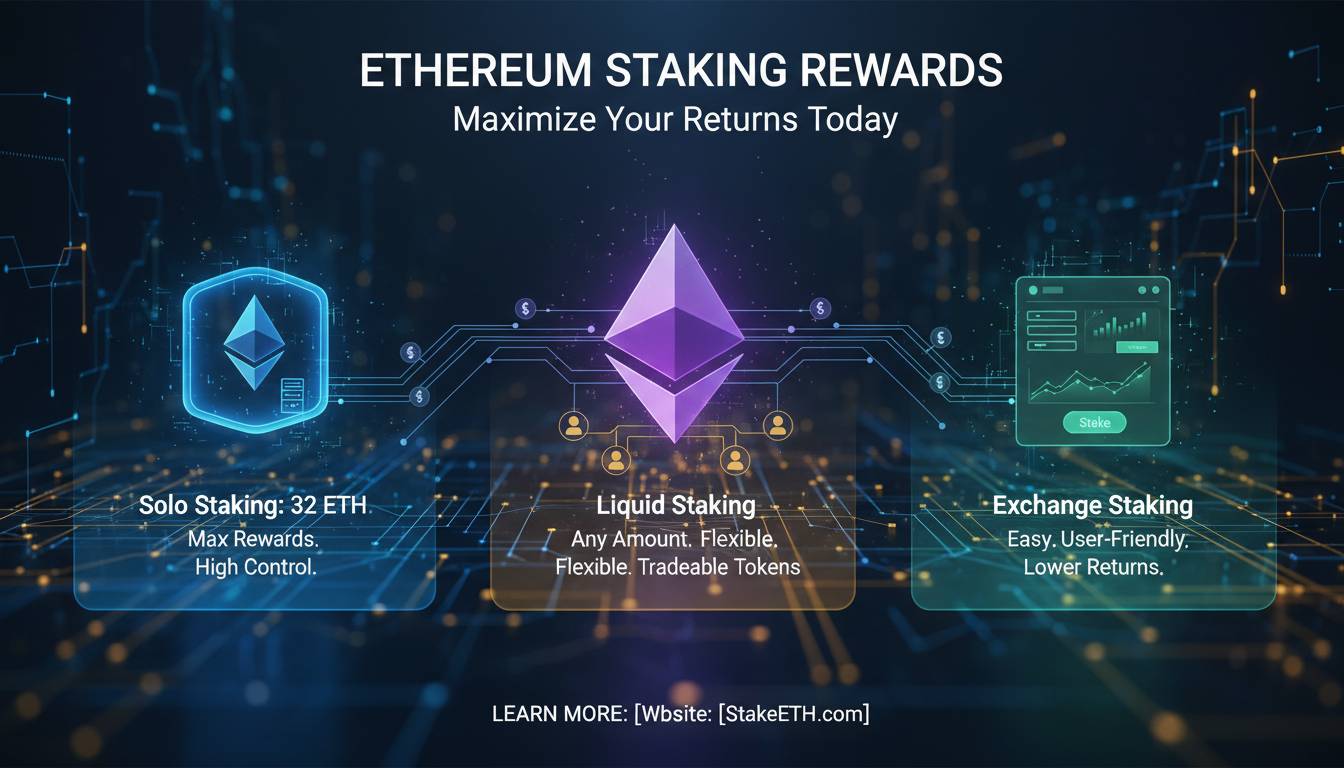
Ethereum staking rewards represent one of the most significant opportunities in decentralized finance, offering investors a way to earn passive income while supporting the network’s security. As the second-largest cryptocurrency by market capitalization, Ethereum’s transition to proof-of-stake has created a robust ecosystem for stakers seeking consistent returns. Understanding how these rewards work, current rates, and strategic approaches can help you make informed decisions about allocating your ETH holdings.
Key Insights
– Ethereum staking rewards currently range from 3-8% annually, varying by method and network conditions
– The Shanghai upgrade enabled stake withdrawals, making staking more flexible since April 2023
– Home staking, staking pools, and liquid staking each offer distinct advantages and trade-offs
– Rewards compound over time, making early participation potentially more valuable
What Is Ethereum Staking and How Does It Work
Ethereum staking involves locking up your ETH tokens to participate in the network’s consensus mechanism. After Ethereum completed its transition from proof-of-work to proof-of-stake in September 2022—known as The Merge—mining was replaced by staking as the method for validating transactions and creating new blocks.
We are thrilled to announce that Ethereum $ETH staking is now live on Gemini!
To celebrate the launch, customers who stake ETH will receive 15% in ETH rewards above the base staking reward rate when staking with us through the end of October.
Learn more: https://t.co/fDZcY9gs1E pic.twitter.com/h9rBi5sJNs
— Gemini (@Gemini) September 29, 2022
When you stake ETH, your tokens become collateral that ensures good behavior. Validators who act honestly earn rewards, while those who act maliciously face penalties, including the potential loss of staked funds. This economic security model eliminates the energy-intensive mining process while maintaining network integrity.
The Ethereum network currently requires a minimum of 32 ETH to run a full validator node. For most investors, this threshold represents a significant capital requirement, which has driven the development of alternative staking solutions that allow participation with smaller amounts.
How Validator Rewards Are Generated
Ethereum validators earn rewards through two primary mechanisms. First, attestation rewards come from voting on the validity of blocks and maintaining consensus. These rewards accrue continuously and constitute the majority of staking income. Second, block proposal rewards occur when a validator is randomly selected to propose the next block in the chain. This selection happens approximately once every 12-15 days on average for each validator.
The total reward rate fluctuates based on several factors, including the total amount of ETH staked across the network, validator performance, and network activity levels. When more ETH is staked, individual rewards decrease—this mechanism helps maintain network security by ensuring sufficient validator participation while preventing过度 centralization.
Current Ethereum Staking Rewards: 2024-2025 Landscape
Understanding the current reward environment is essential for making strategic staking decisions. As of late 2024, Ethereum staking rewards have stabilized following the significant changes introduced by the Shanghai upgrade.
🚨BLACKROCK TO PAY YOU TO HOLD ETH!
The world’s largest asset manager, @BlackRock seeded its new Ethereum $ETH staking ETF with $100K.
It targets up to 95% staking with ~3% yield — but 18% of rewards go elsewhere.
Here’s the catch 👇 https://t.co/aia0YUdYEs pic.twitter.com/5710yhOaqI
— BSCN (@BSCNews) February 18, 2026
Reward Rate Overview
| Staking Method | Annual Yield | Lock-up Period | Minimum ETH Required |
|---|---|---|---|
| Home Staking | 3.5-4.5% | None after withdrawal | 32 ETH |
| Staking Pools | 3-4% | Varies by pool | 0.01 ETH |
| Liquid Staking | 3-4.5% | None | 0.01 ETH |
| Staking as a Service | 3-4% | Varies | 32 ETH |
The base reward rate hovers around 4% annually for standard validator operations, with top-performing validators potentially earning slightly more through superior uptime and efficient block proposals. However, these figures represent gross returns before accounting for operational costs, gas fees, and any platform fees associated with third-party services.
Ethereum Staking vs Holding: 100 ETH (2020–2025)
Summary: Staking 100 ETH from the start of Ethereum’s beacon chain (Dec 1, 2020) through April 15, 2025 would yield significantly more ETH (and thus higher USD value today) than simply holding 100 ETH. Early staking rewards were…
— Dennison (@DennisonBertram) April 15, 2025
Factors Affecting Your Actual Returns
Your individual staking returns depend on several variables. Validator performance directly impacts earnings—validators that maintain high uptime and correctly execute their duties earn more than underperforming nodes. The total network stake matters because rewards are distributed proportionally; as more ETH enters staking, individual yields naturally compress.
Operational costs significantly affect net returns for home stakers. Electricity, internet connectivity, hardware maintenance, and the opportunity cost of capital all factor into your actual earnings. Cloud-based staking services and pools charge fees ranging from 5-20% of rewards, which can substantially reduce net returns compared to running your own validator.
Methods for Staking Ethereum
Investors have multiple pathways to participate in Ethereum staking, each with distinct characteristics suited to different capital levels, technical capabilities, and risk tolerances.
$ETHx is the best way to stake your Ethereum with Ledger.
Simply visit the "Stake" tab on Ledger Live's Ethereum page, choose Stader Labs, and get:
🔹 10% until May 31st
🔹 6% from June 1st to July 31stHighest boosted staking rewards are just a click away.
Stake now. pic.twitter.com/EoaU22blk5
— Stader Ethereum (@staderlabs_eth) May 16, 2024
Home Staking: Maximum Control and Returns
Running your own validator node provides the highest potential returns and maximum control over your staked assets. This approach requires technical knowledge, continuous uptime maintenance, and the 32 ETH minimum threshold.
Requirements for Home Staking:
– Minimum 32 ETH for a single validator
– Dedicated hardware (consumer-grade computer sufficient)
– Stable internet connection with static IP
– Technical capability to manage node operations
– Electricity costs and hardware investment
The primary advantage of home staking is that you retain 100% of the rewards earned, minus operational costs. This approach also contributes directly to network decentralization, as validators distributed across diverse geographic locations and operators enhance Ethereum’s security and censorship resistance.
The main drawback involves the technical barrier to entry and ongoing maintenance responsibilities. Validators must stay current with software updates, monitor for downtime, and handle the slashing risk—a penalty mechanism that can result in partial loss of staked funds if the validator behaves maliciously or experiences significant operational failures.
Staking Pools: Accessible Participation
Staking pools aggregate smaller holdings to meet the 32 ETH threshold, enabling participation from investors who cannot afford to stake independently. These pools function by combining participant funds into a shared validator, distributing rewards proportionally based on each user’s contribution.
Pool operators typically charge fees ranging from 5-15% of staking rewards in exchange for managing the technical complexity. Some pools offer additional features like auto-compounding, where rewards are automatically restaked to maximize compound growth.
The primary consideration when selecting a pool involves evaluating its reputation, fee structure, and centralization risk. Large pools that control significant portions of total staked ETH may inadvertently create concentration concerns, though the Ethereum protocol includes mechanisms to discourage excessive centralization.
Liquid Staking: Preserving Capital Flexibility
Liquid staking derivatives (LSDs) have emerged as one of the most popular staking methods, allowing users to stake ETH while receiving a transferable token representing their staked position. This innovation solves a critical limitation of traditional staking: the inability to use staked assets for other purposes.
When you stake ETH through a liquid staking protocol, you receive an equivalent amount of a liquid token—for example, stETH from Lido or rETH from Rocket Pool. These tokens can be used in decentralized finance applications, traded, or held while your original ETH continues earning staking rewards.
The liquid staking market has grown substantially, with billions of dollars in ETH deposited across various protocols. This growth reflects strong demand for flexible staking options that don’t require locking up assets indefinitely.
How to Maximize Your Staking Returns
Strategic approaches to Ethereum staking can significantly enhance your overall returns. Consider these proven methods for optimizing your staking income.
Optimize Your Validator Performance
If running your own validator, maintaining optimal performance directly increases your earnings. Target 95%+ uptime to maximize attestation rewards. Ensure your hardware has adequate resources to handle validation duties without interruption. Keep your client software updated to benefit from performance improvements and security fixes.
Consider using multiple client implementations to reduce slashing risk. The Ethereum network supports multiple client software options (such as Prysm, Lighthouse, Teku, and Nimbus), and running a minority client reduces the impact of potential bugs that might affect more widely-used clients.
Reinvest Rewards Through Compounding
Compound interest represents one of the most powerful tools for maximizing staking returns. When rewards are automatically reinvested, you earn returns on your accumulated returns, creating exponential growth over time.
Several approaches enable compounding. Some staking pools automatically compound rewards, continuously increasing your stake position. For home stakers, you can manually restake earned ETH by depositing additional funds or running additional validators as your balance grows.
The mathematical impact of compounding becomes substantial over extended time horizons. At a 4% annual yield, your ETH holdings approximately double every 18 years through compounding alone—but the actual growth depends on whether you reinvest rather than withdrawing rewards.
Minimize Fees and Operational Costs
For pool-based staking, fee structures significantly impact net returns. Compare platforms carefully, considering both explicit fees (charged as a percentage of rewards) and implicit costs (such as token redemption delays or spread on liquid staking derivatives).
Consider the total cost of ownership for home staking. Calculate your actual electricity costs, internet expenses, and hardware depreciation. These ongoing costs may exceed initial expectations, particularly in regions with higher energy prices. Sometimes, the convenience of managed staking services justifies their fees when compared to true operational costs.
Risks and Considerations Before Staking
Ethereum staking carries specific risks that investors must understand before committing capital. Proper risk assessment helps ensure staking aligns with your overall investment strategy and risk tolerance.
Slashing and Penalties
The Ethereum protocol includes penalties for validator misbehavior, known as slashing. Minor infractions, such as brief downtime, may result in small penalty deductions. More severe violations, including double-signing or proposed blocks that conflict with network consensus, can result in significant losses—potentially the entire 32 ETH validator deposit.
However, slashing risk for honest validators who maintain proper client configurations remains relatively low. Most slashing events result from operational errors rather than intentional malicious behavior. Using reputable client software, maintaining proper configurations, and staying informed about best practices substantially reduces this risk.
Smart Contract Risk
For users participating through liquid staking or pool-based staking, smart contract vulnerabilities represent an additional risk layer. While major liquid staking protocols have undergone extensive security audits, the decentralized nature of these platforms means bugs or exploits could potentially result in loss of funds.
Mitigate this risk by using well-established protocols with strong security track records, diversifications across multiple platforms, and only staking amounts you’re willing to potentially lose. The DeFi ecosystem continues maturing, but smart contract risk remains inherent to the space.
Opportunity Cost and Market Conditions
Staking locks your ETH with varying degrees of flexibility depending on your chosen method. During periods of significant ETH price appreciation, locked staking positions may prevent you from capitalizing on buying opportunities or other investments that could yield higher returns.
Evaluate whether staking returns adequately compensate for this opportunity cost. While 4% guaranteed returns may seem attractive, alternative investments might offer higher yields during certain market conditions. Your decision should consider both the staking yield and potential alternative uses for your capital.
The Future of Ethereum Staking Rewards
Ethereum’s staking landscape continues evolving, with several developments likely to impact future returns and opportunities.
EigenLayer and Restaking
The emergence of restaking protocols like EigenLayer has introduced new dynamics to Ethereum’s staking ecosystem. Restaking allows validators to leverage their existing staked ETH to secure additional networks, potentially earning supplementary rewards. This development could increase overall yields for stakers while extending Ethereum’s security model to other parts of the crypto ecosystem.
Institutional Participation
Growing institutional interest in Ethereum staking has led to the development of institutional-grade staking products. Major financial institutions and asset managers increasingly offer staking services to their clients, potentially increasing demand for ETH and providing more options for larger-scale stakers.
Network Evolution
Future Ethereum upgrades may continue affecting staking dynamics. Proto-danksharding and subsequent enhancements aim to improve network scalability, potentially increasing transaction throughput and activity levels. These improvements could influence overall network reward structures and validator economics.
Frequently Asked Questions
How much ETH do I need to start staking?
You can start staking with as little as 0.01 ETH by using staking pools or liquid staking services. However, running your own validator requires the full 32 ETH minimum.
Are Ethereum staking rewards taxable in the US?
Yes, staking rewards are generally treated as income in the US and must be reported on your tax return. The fair market value of ETH received as staking rewards at the time of receipt becomes your cost basis for capital gains purposes.
Can I unstake my ETH anytime?
Since the Shanghai upgrade in April 2023, Ethereum supports partial and full unstaking. However, there may be a withdrawal queue depending on network conditions. Liquid staking tokens can typically be redeemed or traded without waiting periods.
What happens if my validator goes offline?
Brief downtime results in small penalty deductions from your staked balance. Extended downtime without proper justification can result in more significant penalties. However, the protocol distinguishes between intentional malicious behavior and honest downtime, with the latter receiving minimal penalties.
Is Ethereum staking safe?
Ethereum staking carries lower risk than many DeFi activities when properly implemented. However, it involves smart contract risk (for pool/liquid staking), operational risk (for home staking), and regulatory uncertainty. Thoroughly research your chosen method and only stake amounts you can afford to lose.
What’s the difference between staking ETH and holding ETH?
Holding ETH exposes you entirely to price movements. Staking generates additional ETH rewards while you hold, effectively providing a yield on your holdings. This yield can significantly enhance total returns during periods of price stability or appreciation, though locked staking reduces your flexibility to respond to price changes.