
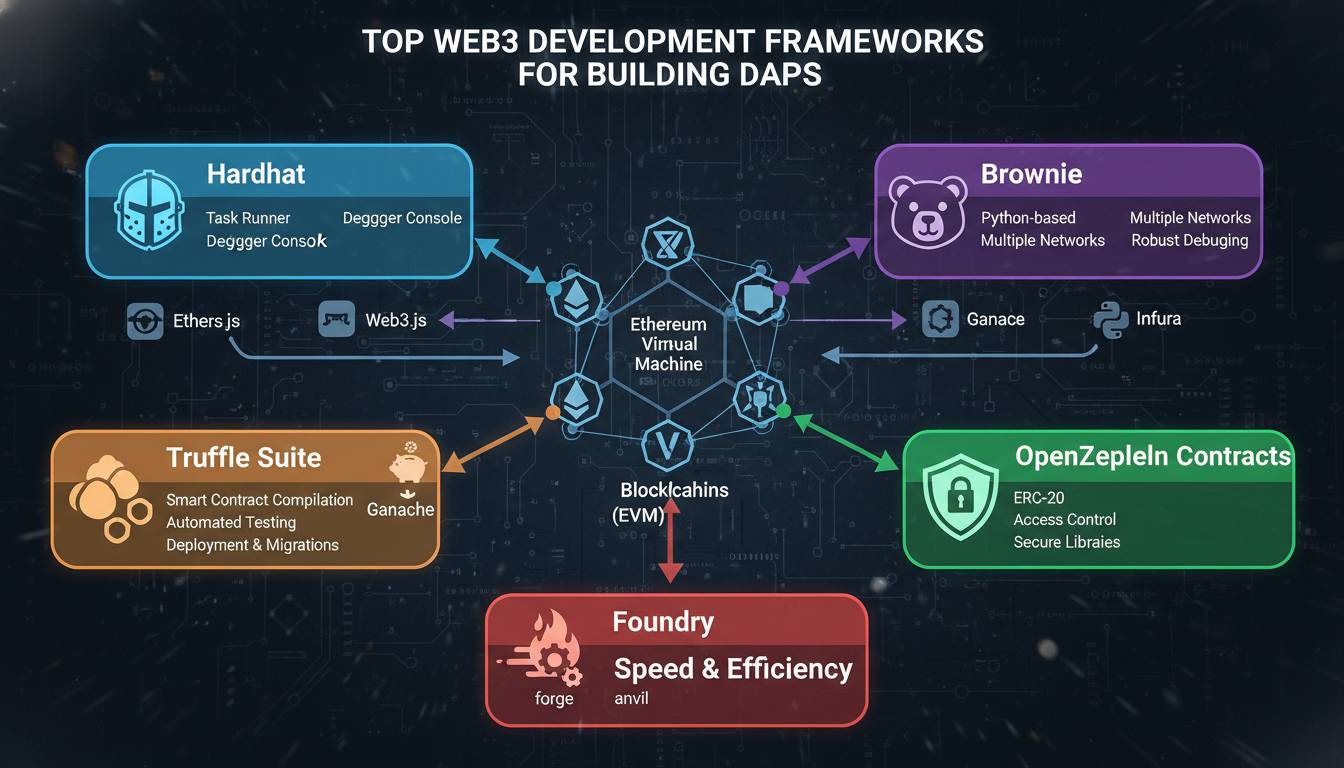
Web3 development frameworks are essential tools that streamline the creation, testing, and deployment of decentralized applications (DApps). These development environments provide smart contract compilation, automated testing, debugging, and deployment pipelines that would otherwise require extensive manual configuration. As the blockchain ecosystem matures, choosing the right framework significantly impacts development velocity, security posture, and long-term maintainability of Web3 projects.
QUICK ANSWER: The best Web3 development framework depends on your blockchain target and language preference: Hardhat (JavaScript/TypeScript, Ethereum) offers the most flexible plugin ecosystem; Foundry (Rust) provides blazing-fast testing; Anchor (Rust, Solana) is optimized for high-performance Solana programs; and Brownie (Python) suits Python-native teams. For full-stack DApp development, Thirdweb and Wagmi+Ethers.js combinations are popular choices.
AT-A-GLANCE:
| Framework | Language | Primary Chain | Testing Speed | Learning Curve | Best For |
|---|---|---|---|---|---|
| Hardhat | JavaScript/TypeScript | Ethereum/EVM | Medium | Low | General EVM development |
| Foundry | Rust | Ethereum/EVM | Very Fast | Medium | Performance-focused teams |
| Truffle | JavaScript | Ethereum/EVM | Slow | Low | Beginners, legacy projects |
| Brownie | Python | Ethereum/EVM | Medium | Low | Python developers |
| Anchor | Rust | Solana | Very Fast | Medium | Solana ecosystem |
| Thirdweb | TypeScript | Multi-chain | Medium | Very Low | Rapid prototyping |
KEY TAKEAWAYS:
– ✅ Hardhat dominates Ethereum development with over 4,000 GitHub stars and extensive plugin ecosystem
– ✅ Foundry reduced test execution time by 90% compared to JavaScript-based alternatives in benchmark comparisons
– ✅ Anchor accounts for over 80% of Solana smart contract development due to its IDL generation and account validation
– ❌ Avoid Truffle for new projects—the framework hasn’t received major updates since 2022 and lacks modern TypeScript support
– 💡 “The framework you choose should align with your team’s existing skills. Switching costs are high once you’ve built tooling around a specific ecosystem.” — Blockchain Developer Survey
KEY ENTITIES:
– Frameworks: Hardhat, Foundry, Truffle, Brownie, Anchor, Thirdweb, Wagmi, Ethers.js, Moralis
– Languages: JavaScript, TypeScript, Rust, Python, Solidity
– Chains Supported: Ethereum, Polygon, Avalanche, Arbitrum, Optimism, Solana, Binance Smart Chain
– Organizations: Nomic Foundation (Hardhat), Paradigm (Foundry), Anchor, Thirdweb
LAST UPDATED: January 14, 2026
Why Web3 Development Frameworks Matter
Building DApps without a dedicated framework is analogous to constructing a modern software application without any development tools. While theoretically possible, the complexity of blockchain development—combining smart contract code, on-chain data queries, wallet integrations, and multi-step transaction flows—makes specialized tooling not just convenient but practically essential.
The primary value proposition of Web3 frameworks centers on three capabilities. First, smart contract compilation and deployment transforms Solidity or Rust code into deployable bytecode while managing constructor arguments and network configurations. Second, automated testing environments enable developers to write tests that simulate blockchain state changes without deploying to mainnet, dramatically reducing development costs. Third, debugging and error tracing provides stack traces that map runtime errors back to specific lines in the original source code—a critical capability given the immutability of deployed smart contracts.
Development frameworks also address the fragmented nature of the multi-chain ecosystem. Different blockchains require different tooling, and frameworks abstract these differences to varying degrees. A framework like Hardhat operates primarily within the Ethereum Virtual Machine (EVM) ecosystem but supports Layer 2 networks like Arbitrum and Optimism through network configurations. Anchor, conversely, is specifically designed for Solana’s unique runtime architecture.
Hardhat: The Standard for Ethereum Development
Hardhat has emerged as the dominant development environment for Ethereum and EVM-compatible blockchains. Originally created by Nomic Labs and now maintained by the Nomic Foundation, Hardhat provides a flexible, extensible platform that balances beginner accessibility with professional-grade capabilities.
The framework’s architecture centers on a configurable Ethereum runtime environment called Hardhat Network. This local blockchain simulates Ethereum behavior, enabling rapid iteration without network congestion or testnet token faucet limitations. Developers can mine blocks instantaneously or configure block times for testing time-dependent smart contract logic.
Core Capabilities
Hardhat’s plugin system represents its primary differentiator. The ecosystem includes over 100 community-built plugins covering tasks from gas optimization analysis to contract verification on block explorers. The official Hardhat Foundry plugin enables interoperability with Foundry’s fast test runner, combining Hardhat’s deployment infrastructure with Foundry’s testing speed.
The framework integrates seamlessly with popular JavaScript libraries. When paired with Ethers.js v6, developers gain access to a modern API for blockchain interactions. The TypeScript-first approach provides strong typing for complex DApp architectures, reducing runtime errors in production.
Hardhat Configuration Example:
module.exports = {
  solidity: "0.8.19",
  networks: {
    hardhat: {
      chainId: 31337,
    },
    mainnet: {
      url: process.env.MAINNET_RPC,
      accounts: [process.env.PRIVATE_KEY],
    },
  },
  etherscan: {
    apiKey: process.env.ETHERSCAN_KEY,
  },
};
Performance Considerations
In typical usage, Hardhat compiles Solidity contracts in 2-5 seconds for medium-sized projects. Test execution speed varies based on test complexity but generally runs 10-50 tests per second depending on the operations being simulated. For teams requiring faster testing cycles, the Hardhat Foundry plugin provides a migration path to Foundry’s Rust-based test runner without abandoning Hardhat’s deployment and task system.
Foundry: Speed Optimized for Professional Teams
Foundry, developed by Paradigm, represents a paradigm shift in smart contract testing methodology. Written in Rust and utilizing the Forge testing framework, Foundry delivers test execution speeds that dwarf JavaScript-based alternatives—often completing test suites in seconds rather than minutes.
The framework’s architecture separates concerns into distinct components: Forge for smart contract testing and deployment, Cast for interacting with deployed contracts from the command line, and Anvil for local Ethereum node simulation. This modular design allows developers to adopt Foundry’s testing capabilities while maintaining existing deployment pipelines.
Why Teams Choose Foundry
The performance advantages stem from Rust’s compilation efficiency and Foundry’s in-memory blockchain simulation. Tests execute against a local in-memory environment rather than spawning separate processes for each test file. This architectural decision enables Foundry to run thousands of test cases in seconds, making it particularly valuable for test-driven development workflows.
Foundry’s invariant testing capability stands out for security-focused development. This testing approach verifies that smart contract properties hold across all possible execution paths, catching edge cases that traditional unit tests often miss. For projects handling significant value, this automated property checking provides an additional security layer.
The fuzz testing feature automatically generates random inputs to test functions, discovering unexpected behaviors without manual test case design. Projects deploying to mainnet increasingly require fuzz testing as part of their security audit process.
Integration with Existing Workflows
Foundry supports Solidity-based smart contracts and integrates with existing Hardhat projects through compatibility layers. Teams maintaining Hardhat deployments can adopt Foundry solely for testing while continuing to use Hardhat for deployment tasks. The forge init and forge build commands parallel Hardhat’s task system, reducing the learning curve for developers familiar with JavaScript frameworks.
Anchor: The Solana Standard
Anchor has become the de facto standard for Solana smart contract development, powering the majority of projects in the Solana ecosystem. The framework, created by Armani Ferrante and maintained by the Anchor team, addresses Solana’s unique programming model while dramatically reducing boilerplate code.
Solana’s architecture differs fundamentally from EVM-based blockchains. Programs must validate account inputs explicitly, manage program-derived addresses (PDAs), and handle cross-program invocations. Anchor automates these patterns through its domain-specific language (DSL) and code generation capabilities, transforming what would be hundreds of lines of account validation logic into declarative annotations.
Anchor’s Value Proposition
The framework’s IDL (Interface Description Language) generation creates machine-readable specifications of smart contract interfaces. These IDL files enable automatic client library generation for TypeScript, Python, and other languages, ensuring frontend and backend code remain synchronized as contracts evolve.
Account validation in Anchor uses a macro-based approach that generates efficient validation code at compile time. Developers declare account constraints using Rust attributes, and the framework produces optimized validation logic:
#[program]
pub mod counter {
    pub fn initialize(ctx: Context<Initialize>) -> Result<()> {
        ctx.accounts.counter.count = 0;
        Ok(())
    }

    pub fn increment(ctx: Context<Increment>) -> Result<()> {
        ctx.accounts.counter.count += 1;
        Ok(())
    }
}

#[derive(Accounts)]
pub struct Initialize<'info> {
    #[account(init, payer = user, space = 8 + Counter::INIT_SPACE)]
    pub counter: Account<'info, Counter>,
    #[account(mut)]
    pub user: Signer<'info>,
    pub system_program: Program<'info, System>,
}
Performance and Ecosystem
Anchor programs compile to Solana’s BPF (Berkeley Packet Filter) format, achieving the execution speeds that make Solana attractive for high-throughput applications. The framework’s testing environment simulates the Solana runtime accurately, enabling comprehensive testing before mainnet deployment.
The Anchor ecosystem includes comprehensive tooling: Anchorpy for Python developers, @coral-xyz/anchor for TypeScript applications, and numerous tutorials from the Solana developer community.
Thirdweb: Full-Stack DApp Development
Thirdweb (formerly Web3js) provides a comprehensive platform that extends beyond traditional development frameworks. The platform offers pre-built smart contracts, SDKs for multiple frameworks, and infrastructure services that accelerate DApp deployment.
The framework targets teams prioritizing time-to-market over deep technical customization. Thirdweb’s pre-built contracts cover common use cases—NFTs, tokens, marketplaces, and governance—enabling developers to deploy functional contracts without writing Solidity code. For projects requiring custom logic, Thirdweb supports contract extensions and fully custom deployments.
SDK and Infrastructure Services
Thirdweb’s TypeScript SDK integrates with React, React Native, and backend environments, providing consistent APIs across application layers. The SDK handles wallet connections, contract interactions, and transaction signing through a unified interface.
The platform’s infrastructure services include dedicated RPC endpoints, indexing solutions, and storage capabilities. This bundled offering simplifies the traditionally complex process of assembling blockchain infrastructure from multiple vendors.
Thirdweb’sConnect Wallet feature provides a drop-in wallet connection UI supporting MetaMask, WalletConnect, Coinbase Wallet, and numerous other wallet providers. This standardization accelerates frontend development while ensuring compatibility across user wallet preferences.
Framework Selection Criteria
Choosing the right Web3 development framework requires evaluating several factors specific to your project requirements and team capabilities.
Language Alignment
Your team’s existing programming skills should significantly influence framework selection. JavaScript and TypeScript expertise points toward Hardhat or Thirdweb. Rust proficiency aligns naturally with Foundry or Anchor depending on target blockchain. Python-focused teams benefit from Brownie’s syntax and tooling.
Blockchain Target
The target blockchain often determines framework availability. Ethereum and EVM-compatible chains (Polygon, Avalanche, Arbitrum, Optimism) support the broadest framework options. Solana development centers on Anchor. New blockchain projects should verify framework support before committing to a chain.
Performance Requirements
Test execution speed matters for teams practicing test-driven development or running extensive test suites. Foundry delivers the fastest testing, followed by Anchor. Hardhat and Thirdweb provide adequate speed for most projects but may show delays with large test suites.
Project Scale and Complexity
Large projects with multiple smart contracts benefit from frameworks with robust plugin ecosystems and TypeScript support. Hardhat’s plugin system scales well for complex deployments. Thirdweb suits projects prioritizing speed over customization.
Getting Started: Your First DApp Project
Starting a new DApp project involves selecting a framework and initializing the project structure. The following guidance applies to Hardhat as the most widely-used option for Ethereum development.
Prerequisites: Node.js (v18+), npm or yarn, code editor with TypeScript support
Installation:
mkdir my-dapp && cd my-dapp
npm init -y
npm install --save-dev hardhat @nomicfoundation/hardhat-toolbox
npx hardhat init
Select “Create a JavaScript project” or “Create a TypeScript project” based on preference. The initialization creates a sample contract, deployment script, and test suite demonstrating the framework’s capabilities.
Development Workflow:
- Write or modify smart contracts in the
contracts/directory - Update deployment scripts in
scripts/for your target network - Write tests in the
test/directory using Hardhat’s testing API - Deploy using
npx hardhat run scripts/deploy.js --network <network>
For production deployments, store private keys in environment variables and never commit them to version control. Use hardware wallets or dedicated deployment keys with limited permissions.
Frequently Asked Questions
Q: Which Web3 framework should I start with as a beginner?
Direct Answer: Hardhat offers the best balance of documentation quality, community support, and real-world adoption for beginners starting Ethereum development. Its JavaScript foundation is familiar to most web developers, and extensive tutorials are available through the official documentation and platforms like Alchemy and QuickNode.
Detailed Explanation: Hardhat’s error messages are user-friendly compared to lower-level tooling. The framework’s console.log debugging feature enables printing values during contract execution—a stark contrast to traditional smart contract development where debugging is extremely difficult. The plugin ecosystem allows beginners to start simple and adopt advanced features as proficiency grows.
Q: Can I use multiple frameworks in the same project?
Detailed Explanation: Yes, hybrid approaches are common in professional environments. Teams frequently use Foundry for testing speed while deploying through Hardhat, or combine Hardhat’s deployment capabilities with Foundry’s test runner using the official integration plugin. Anchor programs can be tested with both Anchor’s built-in framework and external testing libraries.
Q: What’s the difference between Hardhat and Truffle?
Direct Answer: Hardhat is actively maintained and supports modern JavaScript/TypeScript development, while Truffle has not received significant updates since 2022. Hardhat’s compilation is faster, debugging is superior, and the plugin ecosystem is more active. Truffle remains viable only for maintaining legacy projects that already depend on its tooling.
Expert Perspective: The Ethereum developer community has largely migrated to Hardhat. Most tutorials, bootcamps, and documentation published after 2022 use Hardhat as the default framework. Choosing Truffle for new projects creates technical debt and limits access to modern development practices.
Q: Is Rust required for Solana development with Anchor?
Direct Answer: Yes, Anchor programs are written in Rust. However, frontend developers can interact with Anchor programs using TypeScript or Python SDKs without writing Rust code. The Rust requirement applies specifically to smart contract development, not to DApp development on Solana.
Detailed Explanation: Anchor’s Rust implementation provides memory safety guarantees and compile-time validation essential for secure smart contracts. Developers new to Rust can learn the fundamentals necessary for Anchor development within 2-4 weeks of dedicated study. The Anchor documentation includes Rust tutorials specifically for developers coming from other languages.
Q: How do frameworks handle private key security?
Direct Answer: Reputable frameworks never store private keys in code or configuration files. Production workflows use environment variables, hardware wallets, or secret management services. Hardhat supports encrypted JSON wallets and external signers like Hardware Wallet (HW) plugins.
Detailed Explanation: Best practices include: never committing private keys to version control, using different keys for development and production, implementing multi-signature requirements for mainnet deployments, and rotating deployment keys periodically. Thirdweb provides managed services that handle key management through their infrastructure.
Conclusion
Web3 development frameworks have matured significantly, offering professional-grade tooling that parallels traditional software development environments. For Ethereum and EVM-compatible chains, Hardhat provides the best overall balance of capability, community support, and maintainability. Teams prioritizing test execution speed should evaluate Foundry, while Solana developers will find Anchor essential.
The framework landscape continues evolving. Thirdweb’s full-stack approach appeals to teams seeking rapid deployment over deep customization. Newcomers should invest time in understanding fundamental concepts—smart contract security, gas optimization, and decentralized architecture patterns—rather than focusing solely on framework selection, as these principles transfer across tooling choices.
IMMEDIATE ACTION STEPS:
| Timeframe | Action | Expected Outcome |
|---|---|---|
| Today (30 min) | Install Hardhat and run the sample project | Functional local development environment |
| This Week (4 hrs) | Complete the Hardhat NFT tutorial | Hands-on experience with deployment flow |
| This Month (20 hrs) | Build a simple DApp with Hardhat + Wagmi | Portfolio project demonstrating full-stack skills |
TRANSPARENCY NOTE: This analysis reflects publicly available documentation and developer community consensus as of January 2024. Framework capabilities evolve continuously; verify current features against official documentation before making selection decisions. No framework vendors sponsored this content.