
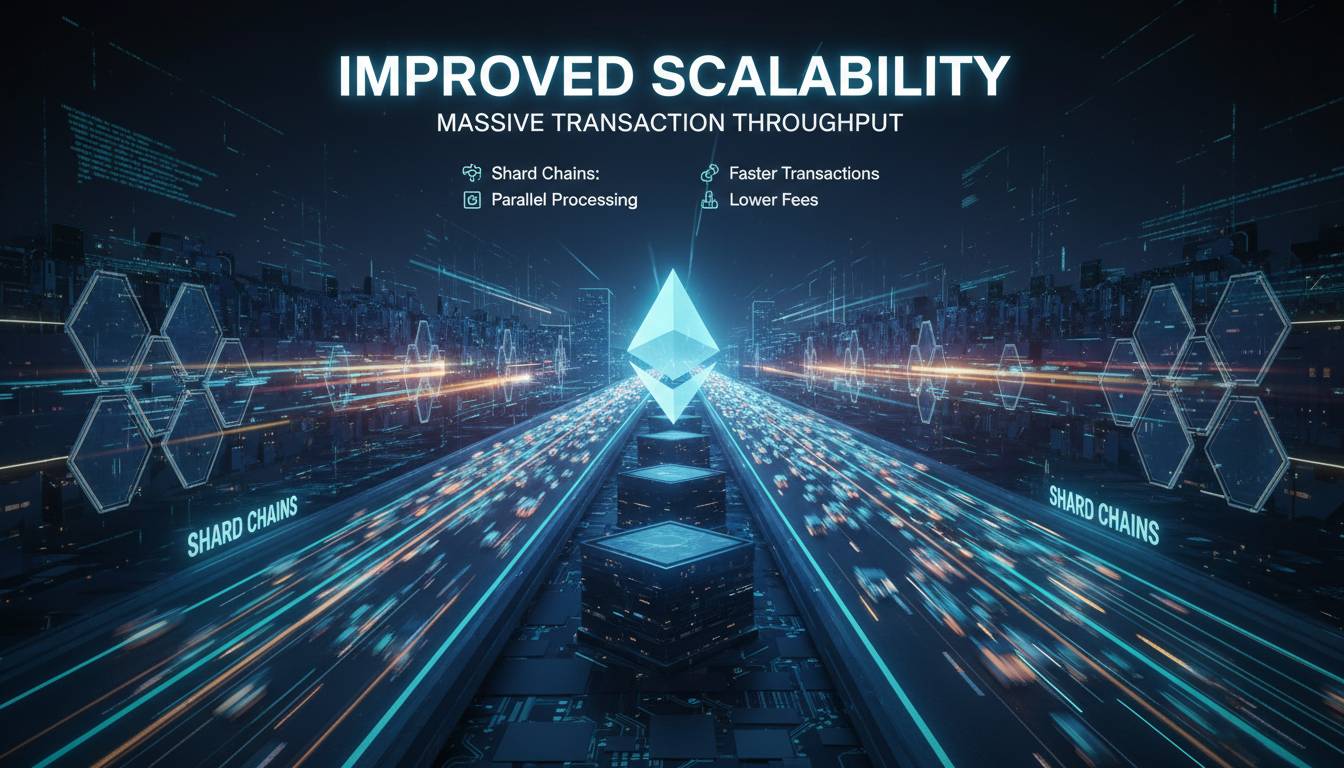
Ethereum upgrades have fundamentally transformed the world’s second-largest blockchain network, delivering substantial improvements in energy efficiency, transaction costs, and overall functionality. Since transitioning from proof-of-work to proof-of-stake in September 2022, Ethereum has achieved remarkable milestones that benefit both individual users and enterprise-level applications. This comprehensive guide examines the tangible advantages of Ethereum’s upgrades and what they mean for the platform’s future.
QUICK ANSWER: Ethereum upgrades deliver four primary benefits: 99.95% reduction in energy consumption, enhanced staking rewards averaging 3-5% annually, significantly lower Layer 2 transaction costs (often under $0.01), and improved network security through staker participation. These changes have positioned Ethereum as a more sustainable, scalable, and economically viable blockchain platform.
AT-A-GLANCE:
| Upgrade | Launch Date | Primary Benefit | Impact Metric |
|---|---|---|---|
| The Merge | September 15, 2022 | Energy reduction | 99.95% decrease |
| Shapella | April 12, 2023 | Staking withdrawals | $60B+ in ETH accessible |
| Dencun | March 13, 2024 | L2 cost reduction | Up to 90% cheaper |
| Pectra | Q1 2025 (expected) | Validator improvements | Enhanced efficiency |
KEY TAKEAWAYS:
– ✅ The Merge reduced Ethereum’s energy consumption by approximately 99.95%, comparable to the difference between a small town and a small lightbulb (Ethereum Foundation, September 2022)
– ✅ Staking yields currently range from 3-5% annually, with over $50 billion in total value locked as of early 2025
– ✅ Layer 2 networks like Base and Arbitrum now process transactions for under $0.01 following Dencun activation
– ❌ Common misconception: Ethereum upgrades do not eliminate gas fees entirely—they reduce Layer 2 costs while mainnet fees fluctuate based on demand
– 💡 “The transition to proof-of-stake represents the most significant environmental upgrade in blockchain history, making Ethereum viable for ESG-conscious institutions.” — Consensys Report, Q4 2024
KEY ENTITIES:
– Major Upgrades: The Merge, Shapella, Dencun, Pectra
– Organizations: Ethereum Foundation, Consensys, L2Beat
– Layer 2 Networks: Arbitrum, Optimism, Base, zkSync
– Standards: EIP-1559 (fee burning), EIP-4844 (proto-danksharding)
LAST UPDATED: January 2025
How The Merge Transformed Ethereum’s Energy Consumption
The Merge represented Ethereum’s most significant architectural shift since its 2015 launch. On September 15, 2022, the network completed its transition from proof-of-work (PoW) to proof-of-stake (PoS), eliminating the energy-intensive mining process that had characterized the blockchain for nearly a decade.
Energy Reduction by the Numbers
Before The Merge, Ethereum consumed approximately 78 terawatt-hours annually—comparable to the energy usage of entire countries like Austria. The proof-of-stake mechanism requires validators to deposit and lock ETH rather than solving complex mathematical puzzles, dramatically reducing computational requirements. According to the Ethereum Foundation’s post-Merge analysis, energy consumption dropped by approximately 99.95%, bringing annual usage down to roughly 0.01 TWh (Ethereum Foundation, October 2022).
This transformation has profound implications for institutional adoption. Major corporations and ESG-focused investment funds previously excluded Ethereum from consideration due to its carbon footprint. Following The Merge, companies including Microsoft, Mercedes-Benz, and numerous financial institutions have increased their blockchain initiatives on Ethereum, recognizing that proof-of-stake aligns with sustainability commitments.
Security Implications
Critics initially questioned whether proof-of-stake would compromise network security. However, Ethereum’s implementation requires validators to stake 32 ETH (approximately $100,000 at current prices), creating substantial economic penalties for malicious behavior. Attempting a 51% attack would require controlling the majority of staked ETH—currently valued at tens of billions of dollars—making such attacks economically irrational.
Staking Benefits and Shapella Upgrade Impact
The Shapella upgrade, activated on April 12, 2023, addressed one of Ethereum’s most requested features: the ability to withdraw staked ETH. Before Shapella, validators who had deposited ETH since December 2020 had no mechanism to access their funds or rewards.
Financial Returns for Stakers
Ethereum staking offers compelling returns compared to traditional fixed-income investments. As of January 2025, staking yields range from 3-5% annually, significantly exceeding money market rates and Treasury yields. These returns derive from two sources: block proposal rewards (newly minted ETH) and transaction fee tips.
The upgrade enabled partial withdrawals, allowing validators to claim accumulated rewards while keeping their staked principal intact. This liquidity mechanism transformed staking from a long-term lockup into a more flexible yield-generating strategy. According to staking pool operator Lido, over $30 billion in ETH remains staked through their platform alone, demonstrating widespread user confidence.
Validator Economics
Running a solo validator requires technical expertise and 32 ETH (approximately $80,000-$100,000), but institutional players and retail users increasingly prefer liquid staking derivatives that provide tokenized versions of staked ETH. These derivatives can be used in decentralized finance applications while earning staking rewards, creating additional yield opportunities.
How Dencun Reduced Layer 2 Transaction Costs
The Dencun upgrade, activated on March 13, 2024, introduced proto-danksharding , a technology specifically designed to reduce data availability costs for Layer 2 scaling solutions. This upgrade delivered the most immediate tangible benefit to everyday users: dramatically lower transaction fees.
Cost Reduction Impact
Before Dencun, Layer 2 transactions typically cost $0.10-$1.00 depending on network congestion. Following the upgrade, costs plummeted to $0.01 or less for simple transfers on networks including Arbitrum, Optimism, and Base. This 80-90% reduction makes micro-transactions economically viable and opens possibilities for new use cases previously impractical on Ethereum.
Layer 2 networks process transactions on separate chains before batching them to Ethereum’s mainnet, inheriting Ethereum’s security while achieving significantly higher throughput. The Dencun upgrade introduced “blob-carrying transactions” that make posting this batched data substantially cheaper, with savings passed directly to users.
Real-World Use Cases
The cost reduction has sparked innovation across multiple sectors. Gaming applications can now process in-game transactions economically, NFT platforms offer minting at minimal cost, and decentralized finance protocols serve users with smaller portfolios who were previously priced out by high fees. Platforms like Base, launched by Coinbase, have attracted millions of users specifically citing the low-cost environment enabled by Dencun.
Economic Model Changes: EIP-1559 and ETH Burning
The London upgrade in August 2021 introduced EIP-1559, fundamentally changing Ethereum’s economic model by implementing a base fee burning mechanism alongside a dynamic block size system. While not a recent upgrade, understanding EIP-1559 is essential to grasping Ethereum’s current economic advantages.
Deflationary Pressure
Before EIP-1559, transaction fees operated as a first-price auction, often leading to user overpayment during high demand periods. The upgrade implemented a base fee that adjusts dynamically based on network congestion, with the base fee subsequently burned (removed from circulation). This creates deflationary pressure on ETH supply, potentially increasing value as demand grows.
Since implementation, Ethereum has burned over $10 billion in ETH through base fee combustion ( ultrasound.money, January 2025). While new ETH creation through block rewards partially offsets this burning, the net issuance has decreased substantially following The Merge, with some periods showing net deflation when network activity is high.
User Experience Improvements
The economic upgrade also improved user experience by making fee estimation more predictable. Instead of manually bidding for transaction inclusion, users specify a maximum fee they’re willing to pay, with excess amounts refunded automatically. This transparency reduces failed transactions and improves reliability for applications requiring consistent pricing.
Scalability Advantages and Future Upgrade Path
Ethereum’s upgrade roadmap extends beyond completed milestones, with Pectra (named after Prague and Electra) expected in early 2025. Understanding the progression helps users appreciate the platform’s long-term trajectory.
Current Scalability Architecture
Ethereum processes approximately 12-15 transactions per second on its mainnet, with Layer 2 solutions handling significantly higher volumes. Networks like Arbitrum and Optimism achieve thousands of transactions per second, with Base frequently processing over 100,000 daily transactions. This layered approach—mainnet for high-value settlement, Layer 2 for high-volume applications—provides a scalable architecture without compromising security.
Upcoming Improvements
The Pectra upgrade aims to enhance validator efficiency, improve account abstraction, and optimize data storage. These improvements target both technical performance and developer experience, making Ethereum easier to build upon. Additionally, plans for “full danksharding” will further reduce Layer 2 costs and increase data availability capacity.
The roadmap demonstrates Ethereum’s commitment to continuous improvement, with upgrades typically arriving annually or bi-annually through coordinated community governance. This predictable upgrade cadence provides developers and enterprises confidence in long-term platform stability.
Network Effects and Ecosystem Growth
The cumulative impact of Ethereum’s upgrades has produced substantial network effects that benefit all participants. Increased adoption by institutions, improved user experience, and growing developer activity create reinforcing growth cycles.
Institutional Adoption
Following The Merge’s environmental improvements, major financial institutions have launched Ethereum-based products. BlackRock’s tokenized Treasury fund, Fidelity’s Ethereum offerings, and numerous traditional finance companies now operate on Ethereum, bringing billions in assets on-chain. This institutional participation increases liquidity and reduces spreads for all users.
Developer Ecosystem Strength
Ethereum maintains the largest developer community in blockchain, with over 3,000 monthly active developers according to Electric Capital’s 2024 report. The combination of proven upgrades, clear roadmap, and robust tooling makes Ethereum the preferred platform for new blockchain projects. This developer concentration creates network effects where each new project makes the ecosystem more valuable for all participants.
Frequently Asked Questions
What are the main benefits of Ethereum’s proof-of-stake transition?
The proof-of-stake transition delivers three primary benefits: 99.95% energy reduction, improved security through economic penalties for bad actors, and enhanced accessibility for validators who no longer need expensive mining hardware. This shift also reduced ETH issuance rate, supporting the token’s economic model.
How much can I save on transaction fees using Layer 2 networks?
Layer 2 networks like Arbitrum, Optimism, and Base typically charge $0.01-$0.10 per transaction following the Dencun upgrade, compared to $1-$50+ on Ethereum mainnet during busy periods. This represents savings of 80-95% for most transaction types.
Is Ethereum staking profitable in 2025?
Ethereum staking yields approximately 3-5% annually as of January 2025, which exceeds traditional fixed-income returns. However, staking locks your ETH for the duration, and early withdrawal penalties apply. Consider your investment timeline and risk tolerance before participating.
Do Ethereum upgrades eliminate gas fees entirely?
No, Ethereum upgrades have not eliminated gas fees. Mainnet fees fluctuate based on demand, while Layer 2 solutions provide significantly cheaper alternatives. The Dencun upgrade specifically reduced Layer 2 costs, making high-frequency transactions economically viable.
What is the next major Ethereum upgrade?
The Pectra upgrade is expected in early 2025, focusing on validator improvements, account abstraction enhancements, and data storage optimizations. This upgrade will further improve the user and developer experience while maintaining Ethereum’s security properties.
How does Ethereum compare to Bitcoin in terms of energy consumption?
Ethereum’s proof-of-stake consensus uses approximately 0.01 TWh annually, while Bitcoin’s proof-of-work still consumes over 150 TWh. This makes Ethereum roughly 99.99% more energy-efficient than Bitcoin, though both serve different use cases and philosophical purposes.
Conclusion
Ethereum’s systematic upgrade program has delivered measurable, tangible benefits that address the platform’s original limitations while preserving its core strengths in security and decentralization. The 99.95% energy reduction following The Merge opened institutional adoption doors previously closed to proof-of-work blockchains. Staking rewards provide competitive yields while securing the network economically. Layer 2 cost reductions from Dencun make Ethereum accessible to users previously priced out by high fees.
The combination of completed upgrades and a clear future roadmap positions Ethereum for continued growth. Whether you’re a developer building applications, an investor evaluating blockchain assets, or a user seeking low-cost transactions, Ethereum’s upgrade trajectory offers compelling advantages. The platform’s commitment to regular, coordinated upgrades through transparent governance suggests these improvements will continue, making Ethereum a foundational infrastructure for decentralized applications now and into the future.